
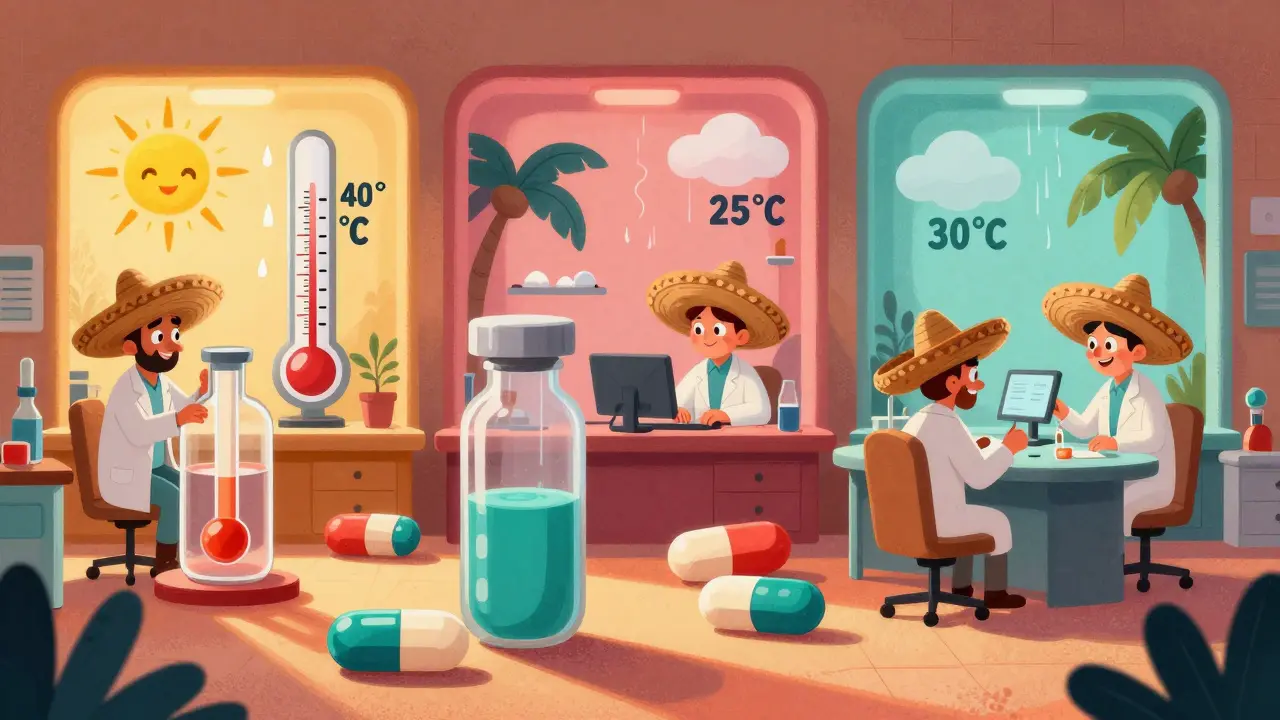
When a new drug hits the market, you don’t just hope it works-you need to know it’ll stay safe and effective for months, even years, under real-world conditions. That’s where stability testing comes in. It’s not optional. It’s not a suggestion. It’s a legal requirement enforced by the FDA, EMA, and every major health agency worldwide. And at the heart of every stability study are two non-negotiable factors: temperature and time.
Why Temperature and Time Matter
Drugs aren’t static. They change. Heat, moisture, and light can break down active ingredients, alter how they dissolve in your body, or even create harmful byproducts. A pill that’s 98% potent on day one might drop to 87% after six months in a hot bathroom. That’s not just a quality issue-it’s a safety risk. Stability testing answers the question: How long can this drug be stored before it becomes unreliable? The answer isn’t guessed. It’s measured. And the measurements follow strict, globally accepted rules. These rules were set by the International Council for Harmonisation (ICH), a group formed in 1990 by regulators from the U.S., Europe, and Japan. Their guideline, ICH Q1A(R2), published in 2003, is still the gold standard today. It doesn’t just tell you what to test-it tells you exactly how to do it.The Three Core Testing Conditions
There are three main types of stability tests, each with fixed temperature and humidity settings. These aren’t suggestions. Deviate from them, and your data won’t be accepted by regulators.- Accelerated testing: 40°C ± 2°C and 75% RH ± 5% RH for 6 months. This isn’t meant to reflect normal storage-it’s a stress test. It simulates what might happen if a shipment gets stuck in a hot warehouse or a package sits in a sun-baked delivery van. If the drug degrades significantly here, you know you’ve got a problem.
- Long-term testing: This is where you prove your product’s real shelf life. You pick one of two conditions based on where you plan to sell it: either 25°C ± 2°C / 60% RH ± 5% RH, or 30°C ± 2°C / 65% RH ± 5% RH. The 25°C/60% RH condition is common in temperate climates like the U.S. and Europe. The 30°C/65% RH condition is required if you’re targeting tropical markets like Southeast Asia or parts of Africa.
- Intermediate testing: 30°C ± 2°C / 65% RH ± 5% RH for 6 months. This is only required if you’re using the 25°C/60% RH condition for long-term testing and you see major degradation in the accelerated test. It’s a bridge between the two, helping you understand how your drug behaves under moderate stress.
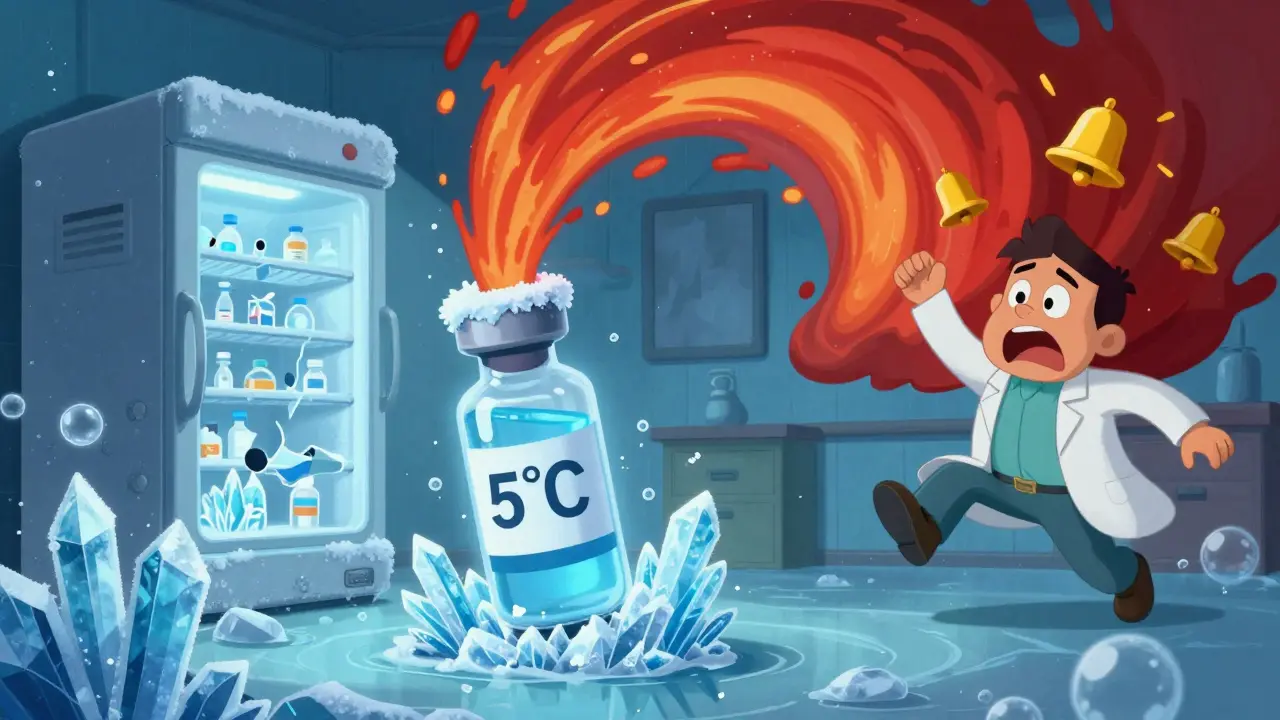
For refrigerated products-like insulin or some biologics-the rules change again. Long-term storage is at 5°C ± 3°C for 12 months. Accelerated testing? Not at 40°C. Instead, it’s 25°C ± 2°C / 60% RH ± 5% RH. That’s because freezing and thawing are the real threats here, not heat.
How Long Do You Have to Test?
Testing doesn’t happen overnight. In fact, you can’t even submit a drug application without enough data.- For long-term studies, you need at least 12 months of data when you apply to the FDA. The EMA allows either 6 or 12 months, depending on your submission route. That difference might seem small, but it can delay global approval by months.
- Accelerated testing always runs for 6 months. No exceptions.
- Intermediate testing? Also 6 months.
But testing doesn’t stop at 12 months. You keep going-often to 24, 36, or even 48 months-to establish the full shelf life. Samples are tested at specific intervals: 0, 3, 6, 9, 12, 18, 24, and 36 months. The early time points (3 and 6 months) are critical because that’s when most degradation happens.
What Counts as a Failure?
It’s not enough to just run the tests. You have to interpret the results correctly. ICH Q1A(R2) defines a “significant change” as:- A 5% change in assay (potency) from the initial value
- Any degradation product exceeding its specification limit
- Failure to meet physical appearance, color, or dissolution criteria
But here’s the catch: these thresholds are vague. A 4.8% drop in potency? That’s under 5%. But in 2022, a Pfizer quality analyst reported a regulator rejecting a batch because of a 4.8% drop-calling it “too close to the limit.” That’s the reality. Regulators don’t always agree on what’s acceptable. One lab’s acceptable trend is another’s warning letter.
And it’s not just numbers. A tablet that cracks, a liquid that turns cloudy, or a capsule that sticks together-even if potency is fine-can trigger a recall. In 2021, Teva had to pull 150,000 vials of Copaxone® because aggregation (clumping) wasn’t detected under accelerated conditions. The problem only showed up after real-world exposure.
Real-World Challenges
Even with perfect protocols, things go wrong.- Chambers fail. A 2023 survey of 142 stability professionals found that 78% had experienced at least one temperature excursion-where the chamber went outside the ±2°C tolerance. One spike can invalidate an entire 12-month study.
- Humidity control is tricky. In dry climates like Arizona or Nevada, maintaining 60% RH requires extra humidifiers. Without them, your data is useless.
- Biologics break the rules. Monoclonal antibodies, mRNA vaccines, and gene therapies don’t degrade like traditional pills. They’re sensitive to shaking, freezing, and even light exposure. The ICH guidelines were written for tablets and capsules-not nanoparticles. That’s why companies like Amgen and Roche got FDA warning letters in 2021 and 2022: their stability data didn’t capture real degradation paths.
And then there’s the waiting. Most drug launches are delayed by stability testing. One CPT Labs survey found 67% of companies had at least one project held up because they didn’t have enough long-term data. That’s 12 to 24 months of waiting just to prove your drug won’t fall apart.
What’s Changing?
The system works-for simple drugs. But the industry is moving fast. New therapies like antibody-drug conjugates, cell therapies, and lipid nanoparticles don’t fit neatly into the 40°C/75% RH box.The ICH is working on a new update-Q1F-expected in late 2024. It’s meant to address these complex products. Meanwhile, companies are turning to predictive modeling. Some use temperatures as high as 80°C to simulate years of degradation in weeks. The FDA is even running a pilot program using real-time sensors during manufacturing to predict stability without waiting months.
But regulators are cautious. In 2022 and 2023, the EMA rejected 8 model-based stability submissions. They still want physical data. For now, the old rules hold.
What You Need to Do
If you’re developing a drug, here’s your checklist:- Choose your long-term storage condition based on your target market (25°C/60% RH for temperate zones, 30°C/65% RH for tropical).
- Run accelerated testing at 40°C/75% RH for 6 months.
- Only run intermediate testing if you see major degradation in accelerated and you’re using 25°C for long-term.
- Test samples at 0, 3, 6, 9, 12, 18, 24, and 36 months.
- Ensure your chambers are qualified (IQ/OQ/PQ) and monitored continuously with ±0.5°C and ±2% RH precision.
- Document everything-protocols, raw data, deviations, and annual reports.
- For refrigerated products, use 5°C ± 3°C for long-term and 25°C/60% RH for accelerated.
There’s no shortcut. No loophole. The temperature and time conditions are locked in. Get them right, and you get approval. Get them wrong, and you risk recalls, delays, or worse-harming patients.
What Happens If You Skip It?
In 2022, the FDA issued 27 warning letters specifically for stability testing failures. That’s not a typo. 27. Companies lost millions in recalls, faced production halts, and saw their products pulled from shelves. One company even lost its marketing authorization entirely.Stability testing isn’t a cost center. It’s your insurance policy. It’s what lets pharmacies stock your drug for 24 months. It’s what lets patients trust that the pill they take today will work the same way next year.
There’s no room for guesswork. Only data. Only precision. Only compliance.
What are the standard temperature and humidity conditions for long-term stability testing?
The ICH Q1A(R2) guidelines define two options for long-term stability testing: 25°C ± 2°C with 60% RH ± 5% RH, or 30°C ± 2°C with 65% RH ± 5% RH. The choice depends on the climatic zone of the target market. For example, 25°C/60% RH is used for temperate regions like the U.S. and Europe, while 30°C/65% RH is required for tropical markets like Southeast Asia or Africa.
How long does accelerated stability testing last?
Accelerated stability testing always runs for 6 months under conditions of 40°C ± 2°C and 75% RH ± 5%. This is a standardized stress test used to predict long-term degradation. It’s required for all new drug submissions, regardless of the product type or target market.
Is intermediate testing always required?
No. Intermediate testing at 30°C ± 2°C and 65% RH ± 5% RH for 6 months is only required if you’re using the 25°C/60% RH condition for long-term testing AND you observe significant degradation during accelerated testing. It’s not needed if you’re already using 30°C/65% RH for long-term studies.
What are the stability requirements for refrigerated drugs?
For refrigerated products like insulin or biologics, long-term storage is at 5°C ± 3°C for a minimum of 12 months. Accelerated testing is not done at 40°C. Instead, it’s conducted at 25°C ± 2°C and 60% RH ± 5% RH for 6 months. This reflects the real risks of freeze-thaw cycles and temperature abuse during transport, not heat degradation.
How much stability data is needed to submit a drug application?
The FDA requires at least 12 months of long-term stability data at the time of submission. The EMA allows either 6 or 12 months, depending on the submission option chosen. Accelerated data (6 months) is always required. Without sufficient data, regulators will not approve the product, regardless of its efficacy.
What happens if a stability chamber has a temperature excursion?
A temperature excursion-where the chamber goes outside the ±2°C tolerance-can invalidate an entire stability study. Even a single 48-hour spike can trigger regulatory scrutiny. Companies must document the event, assess its impact on the samples, and often repeat the study. In a 2023 survey, 32% of stability professionals reported multiple excursions that led to study failure.
Are the ICH stability guidelines the same worldwide?
Yes. ICH Q1A(R2) is adopted identically by the FDA (U.S.), EMA (Europe), Health Canada, PMDA (Japan), and most other major regulators. This global harmonization avoids duplicate testing and saves companies an estimated $1.2 million per product. However, some minor differences exist in submission requirements-for example, the EMA allows 6 months of long-term data, while the FDA requires 12.
Can predictive modeling replace physical stability testing?
Some companies use predictive modeling with high-temperature stress tests (up to 80°C) to estimate shelf life faster. While 74% of top pharmaceutical companies use these methods, regulators like the EMA have rejected 8 model-based submissions since 2022. Physical testing is still mandatory. Modeling may supplement data in the future, but it hasn’t replaced the need for real-time studies under ICH conditions.


Written by Guy Boertje
View all posts by: Guy Boertje