
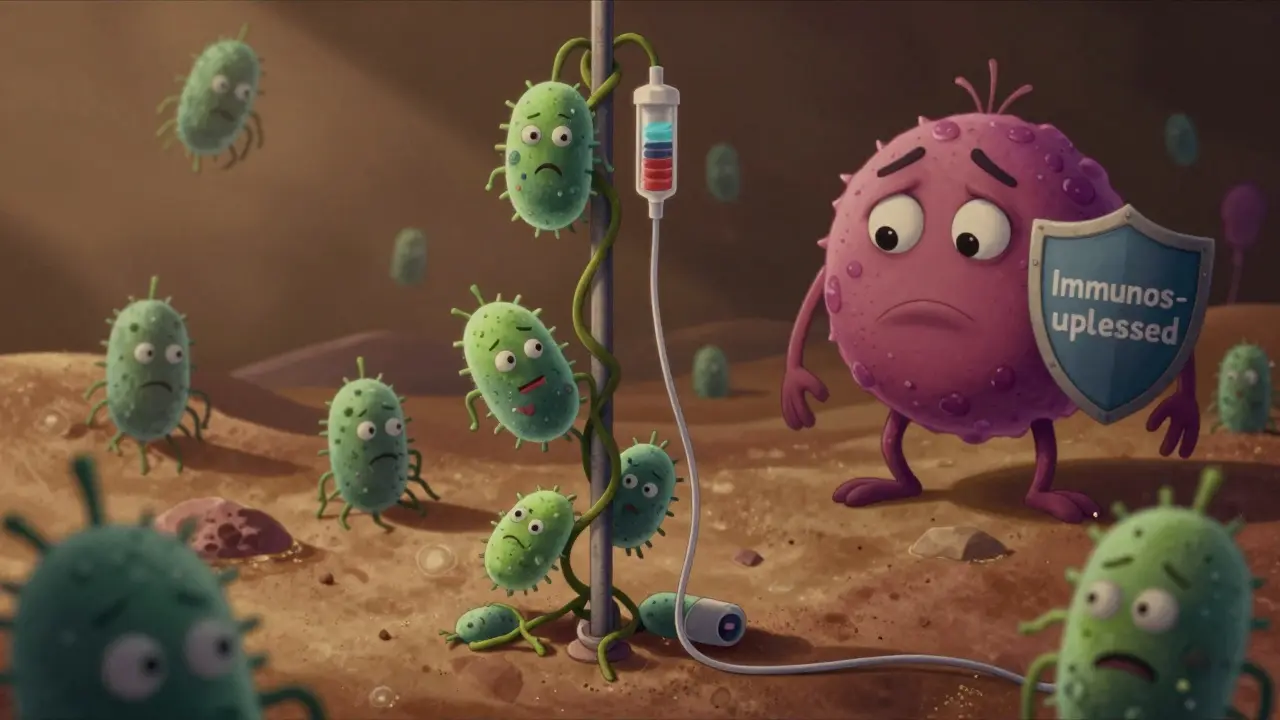
Probiotic Safety Checker for Immunosuppressed Patients
This tool helps you determine if taking probiotics is safe for you based on your medical condition, medications, and immune status. Always consult your healthcare provider before starting any new supplement.
Step 1: Select your medical condition
Transplant specifics
Chemotherapy specifics
Autoimmune specifics
Step 2: Select probiotic type
Risk Assessment Results
Risk Level:
Recommendations
Additional Information
When you’re on immunosuppressants-whether after a transplant, for an autoimmune disease, or during chemotherapy-your body is already walking a tightrope. Your immune system is turned down on purpose to stop it from attacking your new organ or your own tissues. But that same weakened defense makes you vulnerable to things most people’s bodies handle without a second thought. And that includes probiotics.
Probiotics are often marketed as harmless, even helpful, little microbes that boost gut health. But for someone on immunosuppressants, what’s a gentle aid for one person can be a silent threat for another. The truth isn’t black and white. Some people take them without issue. Others end up in the ICU with a bloodstream infection caused by a supplement they thought was safe. So what’s the real risk? And how do you know if you should avoid them-or if you can use them safely?
Why Probiotics Can Be Dangerous When You’re Immunosuppressed
Probiotics aren’t magic pills. They’re live bacteria or yeast. In a healthy gut, they help crowd out bad bugs, strengthen the intestinal lining, and even talk to your immune system. But in someone with a suppressed immune system, those same microbes can slip through the gut wall and enter the bloodstream. Once there, they don’t face the usual defenses. They find a quiet, nutrient-rich space-and start multiplying.
That’s how a harmless Lactobacillus strain, commonly found in yogurt and supplements, can turn into Lactobacillus bacteremia. That’s how Saccharomyces boulardii, a yeast used in some probiotics, can cause fungemia-a fungal infection in the blood. These aren’t theoretical risks. Between 2000 and 2020, 47 documented cases of probiotic-related infections were reported in medical journals. Eighty-three percent of those cases happened in people who were immunosuppressed. Over a third of those patients died.
The biggest danger comes from three groups: people with very low white blood cell counts (neutropenia), those with central lines or catheters, and patients in the first three months after an organ transplant. One study found that patients with central venous catheters who took Saccharomyces boulardii had a 27% higher risk of catheter-related bloodstream infections. And when that infection happens, the fatality rate can hit 22%.
Who’s at Highest Risk?
Not everyone on immunosuppressants is equally at risk. The danger depends on how weak your immune system is and what kind of drugs you’re taking.
- Stem cell transplant patients: This group faces the highest risk. One study showed a 4.2-fold increase in probiotic-related bacteremia compared to those not taking probiotics. Their immune systems are essentially rebuilt from scratch, and for months, they’re defenseless.
- Patients with neutropenia (ANC <500 cells/µL): If your absolute neutrophil count is below 500, your body can’t fight off even minor bacterial invasions. Eighty-seven percent of U.S. cancer centers advise against probiotics during this time.
- People with central lines: Any device that goes directly into your bloodstream is a potential entry point. Probiotic microbes can hitch a ride on the catheter and slip right in.
- Early post-transplant patients: The first 90 days after a liver, kidney, or heart transplant are the most dangerous. Immunosuppression is at its peak. Even a small breach can lead to sepsis.
- HIV patients with CD4 <100: Your immune system is too far gone to control even beneficial microbes. Risk of fungal infections jumps nearly fourfold.
On the other hand, people with stable autoimmune conditions on a single drug-like methotrexate alone-may face much lower risk. Some studies show no increase in infection in this group, especially if their CD4 count is above 200. But even then, caution is advised.
Which Probiotic Strains Are Riskiest?
Not all probiotics are created equal. Some strains are far more likely to cause trouble than others.
Saccharomyces boulardii is the most dangerous. It’s a yeast, not a bacterium, and it’s commonly found in products like Florastor. Yeast doesn’t respond to regular antibiotics. If it gets into your blood, treatment is harder and slower. It’s the culprit in 12 of the 47 documented infection cases between 2000 and 2020.
Lactobacillus rhamnosus GG is the most common strain linked to infections. It’s in over 28% of the cases reported. You’ll find it in brands like Culturelle. It’s generally safe for healthy people-but not for those with compromised immunity.
Even Bifidobacterium, often considered gentler, has been linked to infections in transplant patients. The key takeaway? Don’t assume a strain is safe just because it’s labeled “natural” or “friendly.”
Multi-strain products are riskier than single-strain ones. A 2022 study showed single-strain probiotics had 63% lower translocation risk. More strains mean more chances for something to go wrong.

When Might Probiotics Be Safe-or Even Helpful?
It’s not all doom and gloom. In some cases, the benefits might outweigh the risks.
Liver transplant patients are the exception. A 2022 meta-analysis found that those who took probiotics had a 34% lower rate of bacterial infections-with no increase in serious side effects. That’s the only group where strong evidence supports use.
Some experts suggest that for patients with stable autoimmune disease on low-dose immunosuppressants, a single-strain probiotic might be okay-if approved by a doctor. But even then, it should be done under supervision. One patient on methotrexate for rheumatoid arthritis reported no issues after three years on a specific Lactobacillus strain. But another patient with the same condition developed sepsis after taking a different product. Context matters.
There’s also emerging research on postbiotics. These are inactivated microbial cells or their metabolic byproducts-like short-chain fatty acids or enzymes. They may offer immune-modulating benefits without the infection risk because they’re not alive. A 2023 clinical trial showed a 40% reduction in C. difficile infections in immunosuppressed patients using postbiotics-with zero adverse events. This could be the future of safe gut support.
What Should You Do? A Practical Guide
If you’re on immunosuppressants, here’s what you need to do right now:
- Stop taking any probiotic supplement immediately if you’re unsure. Don’t wait for symptoms.
- Know your risk level: Are you neutropenic? Do you have a central line? Were you transplanted within the last 90 days? If yes, probiotics are not safe.
- Talk to your doctor or infectious disease specialist. Don’t rely on your pharmacist, nutritionist, or Google. Ask specifically: “Is it safe for me to take probiotics given my current meds and immune status?”
- If approved, use only single-strain products. Avoid anything with multiple strains. Look for the exact strain name-like Lactobacillus rhamnosus GG ATCC 53103-not just “Lactobacillus.”
- Avoid Saccharomyces boulardii at all costs. This yeast is the most dangerous. Check labels carefully. It’s often hidden under names like Florastor, Biocare, or Saccharomyces cerevisiae.
- Watch for warning signs: Fever over 101°F, chills, unexplained fatigue, or abdominal pain. If you’re taking a probiotic and develop these, stop it immediately and get blood cultures done.
And don’t assume that because a product is sold in a pharmacy or labeled “doctor-recommended,” it’s safe for you. The FDA treats probiotics as dietary supplements, not drugs. That means they don’t have to prove safety for immunocompromised users before hitting the shelf.

The Bigger Picture: Regulation, Research, and Reality
The global probiotic market is worth over $50 billion. But regulation is a mess. In the U.S., probiotics aren’t reviewed for safety before sale. The European Food Safety Authority rejected 95% of health claims for probiotics between 2010 and 2020 because the evidence was weak. Yet, they’re still sold everywhere-from grocery stores to Amazon.
Hospitals are starting to catch up. Sixty-two percent of U.S. academic medical centers now have formal protocols for probiotic use in immunosuppressed patients, up from 28% in 2018. But most patients never hear about these rules. They buy supplements on their own, often because they’re desperate for relief from digestive side effects of their meds.
There’s hope on the horizon. The PROTECT registry, launched in 2023, is tracking 5,000 immunosuppressed patients across 47 centers to build better guidelines. Preliminary results are due in mid-2025. And the FDA just issued a safety warning in July 2023 requiring warning labels on all products containing Saccharomyces boulardii for immunocompromised users.
For now, the safest choice is simple: if you’re on immunosuppressants, don’t take probiotics unless your doctor specifically says it’s okay-and even then, only with a single-strain product and no yeast.
What About Food Sources? Can I Eat Yogurt?
This is a common question. The answer: it’s complicated.
Fermented foods like yogurt, kefir, sauerkraut, and kimchi contain live microbes-but in much smaller amounts than supplements. They also come with other nutrients and aren’t concentrated. For most people on stable immunosuppression, eating small amounts of plain yogurt is generally considered low risk. But if you’re neutropenic, in the early post-transplant phase, or have a central line, even food-based probiotics can be risky.
Stick to pasteurized, plain yogurt without added sugars or live cultures listed as “probiotic.” Avoid raw or unpasteurized fermented foods-they carry higher contamination risks.
If you’re unsure, ask your dietitian. They can help you find safe alternatives to support gut health without introducing live microbes.
Alternatives to Probiotics for Gut Health
You don’t need live bacteria to support your digestive system. There are safer options:
- Prebiotics: These are fibers that feed your good gut bacteria. Think chicory root, garlic, onions, asparagus, and oats. They’re safe for immunosuppressed patients because they’re not alive.
- Postbiotics: As mentioned earlier, these are compounds made by bacteria that can support immunity and gut barrier function without live microbes. They’re not widely available yet, but research is promising.
- Diet and hydration: Eating plenty of fiber, staying hydrated, and avoiding processed foods can do more for your gut than any supplement.
- Medications: If you’re on antibiotics, your doctor might prescribe a non-live agent like fidaxomicin for C. difficile prevention instead of probiotics.
The goal isn’t to eliminate gut health-it’s to protect your body while you’re vulnerable. Sometimes, the best thing you can do is nothing at all.
Can probiotics cause infections in people on immunosuppressants?
Yes. Probiotics contain live bacteria or yeast that can cross the gut barrier in immunosuppressed individuals and enter the bloodstream, causing serious infections like bacteremia or fungemia. Cases have been documented in patients on transplant drugs, chemotherapy, or with low white blood cell counts. The most dangerous strains include Lactobacillus rhamnosus GG and Saccharomyces boulardii.
Is it safe to take probiotics after an organ transplant?
It’s generally not safe in the first three months after transplant, when immunosuppression is strongest. After that, some patients-especially liver transplant recipients-may benefit under medical supervision. But even then, only single-strain, non-yeast probiotics should be considered. Always consult your transplant team before starting anything.
What probiotics should I avoid if I’m on immunosuppressants?
Avoid all products containing Saccharomyces boulardii (e.g., Florastor), multi-strain formulas, and any probiotics labeled for “immune support.” Also avoid Lactobacillus rhamnosus GG if you’re neutropenic or have a central line. Stick to plain, single-strain options only if approved by your doctor-and even then, with caution.
Can I eat yogurt while on immunosuppressants?
Plain, pasteurized yogurt without added live cultures is usually low risk for stable patients. Avoid raw, unpasteurized, or heavily marketed “probiotic” yogurts. If you’re neutropenic or recently transplanted, even yogurt should be avoided. Always check with your care team.
Are there safer alternatives to probiotics for gut health?
Yes. Prebiotics like oats, garlic, and onions feed your natural gut bacteria without introducing live microbes. Postbiotics-non-living microbial compounds-are emerging as a promising alternative and are currently being tested in clinical trials. Diet, hydration, and fiber intake are also powerful, safe tools for supporting gut health.


Written by Connor Back
View all posts by: Connor Back