
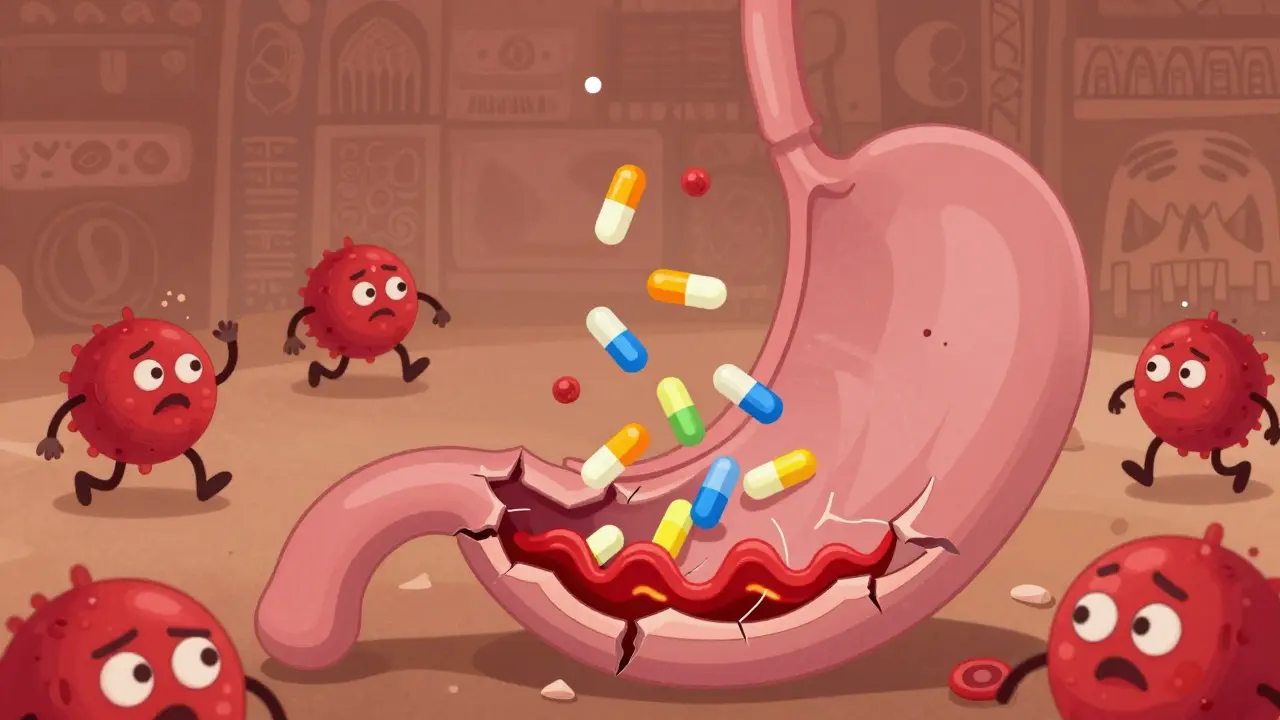
Every year, millions of people reach for NSAIDs to ease joint pain, headaches, or muscle soreness. Ibuprofen, naproxen, diclofenac - these are household names. But what most users don’t realize is that these common pain relievers are quietly damaging their stomach lining, sometimes with life-threatening results. NSAIDs are among the leading causes of gastrointestinal bleeding, and the risk doesn’t just affect older adults or those with a history of ulcers. It’s happening to people who think they’re being careful - taking one pill a day, skipping doses, or using over-the-counter versions without telling their doctor.
How NSAIDs Cause Bleeding
NSAIDs work by blocking cyclooxygenase enzymes, or COX enzymes, which control inflammation and pain. But these same enzymes also help protect the stomach and intestinal lining by producing prostaglandins - chemicals that maintain blood flow to the gut and stimulate mucus production. When NSAIDs shut down COX-1, that protective layer breaks down. The stomach’s natural acid starts eating away at the tissue. This isn’t always a dramatic ulcer you’d see on an endoscopy. Sometimes it’s just tiny erosions, slow oozing, or hidden bleeding that shows up later as iron deficiency anemia.
Research from the Cleveland Clinic Journal of Medicine shows that 86% of patients with lower GI bleeding had taken NSAIDs - even when no ulcer was visible. That means you don’t need a classic peptic ulcer to bleed. The damage can occur anywhere from the stomach down to the small intestine. And because this bleeding is often slow and silent, many people don’t realize they’re losing blood until they’re dizzy, fatigued, or their hemoglobin drops below 9 g/dL.
The Real Numbers Behind the Risk
A 2020 JAMA Internal Medicine meta-analysis found that NSAID use triples to quadruples your risk of upper GI bleeding or perforation. The relative risk? Between 3.2 and 4.2, depending on the study. That’s not a small increase. It’s like flipping a coin and having it land heads 4 out of 5 times - except the stakes are internal bleeding.
Not all NSAIDs are equal. Non-selective ones like naproxen and diclofenac carry the highest risk. A 2000 Lancet study comparing celecoxib (a COX-2 inhibitor) to ibuprofen showed a 50% lower rate of serious ulcers with celecoxib. But here’s the catch: COX-2 inhibitors like celecoxib and etoricoxib raise your risk of heart attack. The 2004 APPROVe trial found rofecoxib (Vioxx) increased heart attack risk by over 90%. So you’re trading one danger for another.
And it gets worse. When NSAIDs are taken with blood thinners like warfarin or aspirin, bleeding risk jumps again. A 2017 Clinical Pharmacology & Therapeutics study found that combining NSAIDs with anticoagulants multiplies the risk by more than double. Even corticosteroids - often prescribed for arthritis or autoimmune conditions - raise the odds by 80%.
Who’s Most at Risk?
If you’re over 65, you’re already in the danger zone. Each decade of age increases your risk by 60%. But it’s not just age. Dr. John D. Wolfe’s 1999 study identified five clear red flags:
- History of peptic ulcer or GI bleeding (2.5x higher risk)
- Age over 70 (1.6x higher risk per decade)
- Use of corticosteroids (1.8x higher risk)
- High-dose NSAIDs (over 1,200 mg/day of ibuprofen - 2.1x higher risk)
- Taking more than one NSAID at once (1.9x higher risk)
And don’t forget anticoagulants - they add another 2.3x risk. If you have two or more of these factors, you’re not just at risk. You’re in the high-risk category. The American College of Gastroenterology says you need protection - not just avoidance.

What Actually Works to Protect Your Gut
Stopping NSAIDs isn’t always an option. Many people with arthritis or chronic back pain rely on them. So what’s the fix?
Proton pump inhibitors (PPIs) like omeprazole, esomeprazole, or pantoprazole are the gold standard. A 2017 Cochrane review of over 13,000 patients found PPIs cut NSAID-related ulcer complications by 75%. That’s not a suggestion - it’s a medical necessity for high-risk users. The American Gastroenterological Association recommends starting PPIs before you even begin NSAID therapy if you’re at high risk.
Another option is misoprostol, a synthetic prostaglandin that replaces what NSAIDs destroy. It reduces ulcer risk by 50-75%. But it comes with a cost: diarrhea in up to 20% of users, abdominal cramps, and nausea. Most people can’t tolerate it long-term.
Then there’s the new kid on the block: combination pills like Vimovo (naproxen + esomeprazole). Approved by the FDA in 2023, this single tablet delivers pain relief and gut protection together. The 2022 PRECISION-2 trial showed a 7.3% ulcer complication rate with Vimovo versus 25.6% with naproxen alone. That’s a 72% drop. It’s not cheap, but for high-risk patients, it’s a game-changer.
The Hidden Problem: Over-the-Counter Use
Most people think OTC NSAIDs are safe because they’re available without a prescription. But here’s the truth: 26% of users take more than the recommended dose, according to a 2021 Clinics in Medicine review. And nearly two-thirds never tell their doctor.
On patient forums like HealthUnlocked, 63% of NSAID users reported stomach pain, nausea, or black stools - but only 37% brought it up with their provider. On Reddit, one user described how their 78-year-old mother needed three blood transfusions after months of undiagnosed bleeding from daily ibuprofen use. She didn’t know it was connected.
The Arthritis Foundation’s 2022 survey found that 42% of people stopped taking NSAIDs because of GI symptoms. That’s almost half. But they didn’t stop because they were warned - they stopped because they felt awful.

What Should You Do?
If you’re taking NSAIDs regularly - even just a few days a week - here’s what you need to do:
- Ask yourself: Do I have any risk factors? Age over 65? History of ulcers? Taking blood thinners or steroids?
- If yes to one or more - talk to your doctor about PPI therapy. Don’t wait for symptoms.
- If you’re on OTC NSAIDs, track your dose. Don’t exceed 1,200 mg of ibuprofen or 500 mg of naproxen per day without medical advice.
- Watch for signs of bleeding: dark, tarry stools; unexplained fatigue; dizziness; or pale skin. These aren’t normal.
- Consider alternatives. Acetaminophen (Tylenol) doesn’t harm the gut. Physical therapy, heat therapy, or low-dose antidepressants like amitriptyline can help chronic pain without the bleeding risk.
For those with two or more risk factors, the American College of Rheumatology 2023 guidelines are clear: use a COX-2 inhibitor with a PPI. It’s not about avoiding NSAIDs. It’s about using them safely.
The Bigger Picture
NSAID-related GI complications cause 107,000 hospitalizations and 16,500 deaths each year in the U.S. alone. The annual cost? $2.2 billion. That’s not just a medical issue - it’s a systemic failure. Too many patients are left to guess whether their stomach pain is just indigestion or a warning sign.
And yet, NSAIDs aren’t going away. They’re too effective, too cheap, and too widely used. The Institute for Clinical and Economic Review projects they’ll remain first-line therapy for arthritis and inflammation because, at $12,500 per quality-adjusted life year, naproxen with PPI is far more cost-effective than celecoxib at $45,200.
The future may hold safer options - like CINODs (COX-inhibiting nitric oxide donators). Naproxcinod, currently in phase III trials, cut endoscopic ulcers by half compared to naproxen in the 2021 NAPROX-2 study. But until then, the solution is simple: know your risk. Protect your gut. And never assume an OTC pill is harmless.
Can I take ibuprofen if I’ve had a peptic ulcer before?
No - not without serious precautions. If you’ve had a peptic ulcer or GI bleeding in the past, your risk of another bleed is over 2.5 times higher. The American College of Gastroenterology recommends avoiding all NSAIDs unless absolutely necessary. If you must use one, combine it with a proton pump inhibitor (PPI) like omeprazole. For the highest protection, use a COX-2 inhibitor (like celecoxib) with a PPI. Never take NSAIDs alone after a prior bleed.
Are over-the-counter NSAIDs safer than prescription ones?
No. OTC NSAIDs carry the same risks as prescription ones - sometimes more, because people take them longer and at higher doses without medical oversight. Studies show 26% of users exceed the recommended daily limit. Many don’t tell their doctor they’re taking them, so doctors can’t assess risk. The dose doesn’t make it safer - the duration and frequency do. A daily 200 mg ibuprofen tablet for months can be just as damaging as a prescription-strength dose taken for a week.
Do all NSAIDs cause bleeding, or are some safer?
All NSAIDs carry some risk, but not equally. Non-selective NSAIDs like naproxen, diclofenac, and ibuprofen block both COX-1 and COX-2 enzymes. That means they destroy gut protection as well as reduce pain. Selective COX-2 inhibitors (like celecoxib) spare COX-1, so they’re gentler on the stomach - but they raise heart attack risk. The safest choice isn’t the least painful - it’s the one with the least harm. For most people, that means using the lowest effective dose for the shortest time, paired with a PPI if they have risk factors.
Can PPIs completely prevent NSAID-induced bleeding?
PPIs reduce the risk by about 75%, but they don’t eliminate it. A 2017 Cochrane review of 33 trials showed PPIs cut ulcer complications from 10.8% to 2.7% in high-risk users. That’s a huge drop - but 2.7% still means 1 in 37 people will have a problem. PPIs work best when started before NSAID use, not after symptoms appear. They also don’t protect the lower GI tract as well as the upper tract. So if you’re still bleeding despite taking a PPI, your doctor needs to investigate further.
What are the signs of hidden NSAID bleeding?
Hidden (occult) bleeding doesn’t always cause black stools or vomiting blood. Often, it shows up as unexplained fatigue, shortness of breath, pale skin, or dizziness - signs of anemia from slow blood loss. Iron deficiency anemia is one of the most common but overlooked results of long-term NSAID use. If you’ve been taking NSAIDs for months and your doctor says your iron is low, ask if NSAIDs could be the cause. A simple stool test for occult blood can confirm it.


Written by Guy Boertje
View all posts by: Guy Boertje