
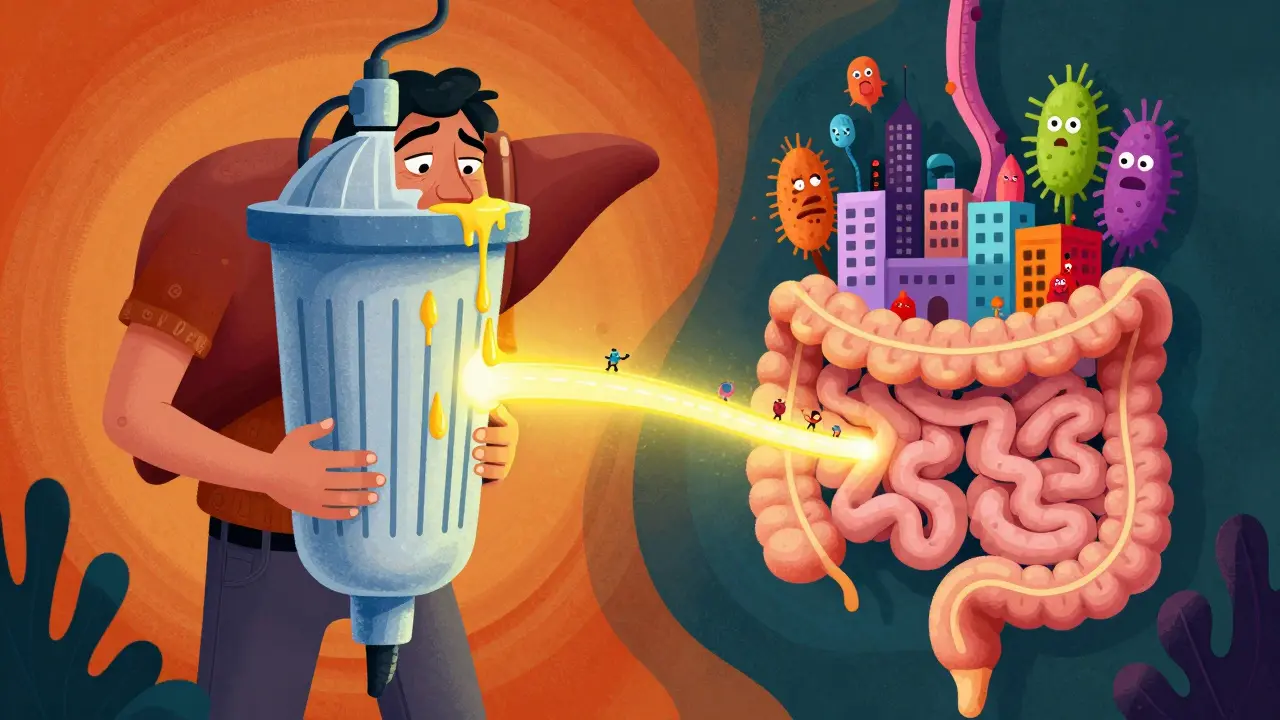
For a long time, doctors looked at the liver in isolation. Now, we know about the "gut-liver axis." Think of this as a direct highway between your intestines and your liver. When your gut health slips, "leaks" in the intestinal wall allow toxins and inflammatory markers to travel straight to the liver. This triggers inflammation and can turn simple fat buildup into something more serious, like NASH or cirrhosis. The good news? Because the gut is so influential, changing what you eat and how much you weigh can actually "reprogram" this axis to help your liver heal.
The Connection Between Your Gut and Your Liver
To understand how to fix the liver, we have to look at Gut Microbiome Dysbiosis. This is a fancy way of saying your gut bacteria are out of balance. In people with NAFLD, there is often a lack of diversity in these bacteria. Specifically, there is a drop in short-chain fatty acids (SCFAs) like butyrate. These fatty acids are like armor for your gut lining; without them, the lining becomes permeable.
When the gut barrier fails, substances called lipopolysaccharides (LPS) leak into the portal vein. Research shows that people with NAFLD have LPS levels in their system more than twice as high as healthy people. These toxins act like a flare gun, signaling the liver to trigger an inflammatory response. Furthermore, the way your gut bacteria process bile acids affects how your liver handles lipids. When the right bacteria are present, they activate receptors like FXR and TGR5, which naturally tell the liver to stop hoarding fat.
Weight Loss: The Gold Standard for Recovery
If there is one "magic bullet" for liver health, it is weight loss. It is not about reaching a supermodel physique; it is about shifting the metabolic load. Clinical data shows that losing just 5% to 7% of your total body weight can improve simple fat accumulation (steatosis) in about 81% of patients. If you can push that to 10% weight loss, nearly half of those with the more severe form, NASH, see a total resolution of the disease.
How do you get there without crashing? A steady deficit of 500 to 750 calories per day is usually the sweet spot, aiming for a loss of about 0.5 to 1kg per week. Fast results often lead to relapses. For example, structured programs that combine diet and behavioral coaching have a much higher success rate-68% of patients stay in remission after two years, compared to only 29% of those trying to do it on their own. This suggests that the "how" of weight loss is just as important as the number on the scale.
Eating for Your Liver and Gut
Diet isn't just about calories; it is about providing the raw materials your gut bacteria need to protect your liver. The Mediterranean Diet is widely considered the best approach here. It focuses on monounsaturated fats-think olive oil and avocados-and plenty of fiber. One study found that adding 30g of walnuts a day to this diet reduced liver fat by 32% over six months. Why? Because walnuts provide prebiotic fibers that feed the "good" bacteria.
| Category | What to Increase | What to Limit | Why it Matters |
|---|---|---|---|
| Fats | Olive oil, Avocados, Walnuts | Saturated & Trans fats | Reduces inflammation in the liver |
| Carbs | Whole grains, Leafy greens | Refined sugars, White bread | Prevents insulin spikes and fat storage |
| Sugars | Low-glycemic fruits | Fructose (<25g/day) | Fructose is processed directly by the liver |
| Fiber | Legumes, Broccoli, Oats | Processed snacks | Feeds bacteria that produce butyrate |
One specific enemy to watch out for is fructose. Unlike other sugars, fructose is processed almost exclusively by the liver. Too much of it acts like fuel for fat production. Keeping fructose intake below 25g per day helps stop the cycle of fat accumulation. Aim for 25-30g of total fiber daily to keep your gut lining strong and your liver clean.
Using Probiotics and Prebiotics
Can you take a pill to fix your liver? Maybe, but they are assistants, not the main act. Probiotics-live beneficial bacteria-can help. Multi-strain formulas containing Lactobacillus rhamnosus GG and Bifidobacterium longum have been shown to reduce liver fat by 23% and lower ALT levels (a marker of liver damage) by 31% over 24 weeks.
Then there are Prebiotics, which are non-digestible fibers that act as food for the good bacteria. Inulin and fructo-oligosaccharides are two powerhouses here. Taking 10g of inulin daily can increase butyrate levels in your gut by 47%, which in turn reduces liver stiffness. While the European Association for the Study of the Liver (EASL) views these as "potentially beneficial," they aren't a replacement for weight loss. Think of them as a way to optimize the environment while you do the hard work of dieting and exercising.
Moving Toward MASLD: What's Changing?
You might hear a new term: MASLD (Metabolic Dysfunction-Associated Steatotic Liver Disease). As of 2024, the medical community is shifting away from the term "nonalcoholic" because it defines the disease by what it isn't rather than what it is. MASLD highlights that the root cause is metabolic-meaning it's tied to how your body handles insulin, sugar, and fat.
This shift is important because it focuses the treatment on the metabolic drivers. We are seeing the rise of "defined bacterial consortiums"-specialized blends of bacteria designed to activate the FXR receptor in the gut to flush out liver fat. Some early phase 3 trials show a 38% reduction in liver fat using these targeted bacterial therapies. We are moving toward a future where your doctor might test your gut microbiome and prescribe a specific strain of bacteria tailored to your liver's needs.
Practical Steps for Your Journey
Changing your liver health doesn't happen overnight. It requires a multidisciplinary approach. Start by focusing on the "low-hanging fruit": swap your refined cooking oil for extra virgin olive oil and replace one sugary snack with a handful of walnuts. If you feel overwhelmed, consider a structured program or a registered dietitian. Self-directed attempts often fail because of "social eating" and cravings, but structured support nearly triples the chance of long-term success.
Keep an eye on your markers. If you are tracking your progress, look at your ALT and AST levels. A drop in these enzymes, combined with a gradual weight loss of 0.5kg a week, is a strong sign that your gut-liver axis is healing. Remember, the goal isn't perfection; it's consistency. Small, daily choices in the kitchen lead to massive changes in the liver.
Can I reverse fatty liver without medication?
Yes, in many cases. Weight loss of 5-10% of total body weight is considered the first-line therapy. For about 81% of people, this amount of weight loss improves simple steatosis, and for 45% of those with NASH, it can lead to total resolution of the disease when combined with a Mediterranean-style diet.
Which probiotics are best for NAFLD?
Multi-strain formulations are generally more effective than single strains. Look for those containing Lactobacillus rhamnosus GG, Bifidobacterium longum, and Streptococcus thermophilus. For clinical results, a dose of 10^9 to 10^10 CFU per day for at least 12 weeks is typically recommended.
Why is fructose bad for the liver?
Unlike glucose, which can be used by any cell in the body, fructose is processed almost entirely by the liver. When you consume too much (especially in high-fructose corn syrup), the liver converts the excess into fat, which contributes directly to the accumulation of hepatic fat seen in NAFLD/MASLD.
What is the gut-liver axis exactly?
The gut-liver axis is the bidirectional communication system between the gastrointestinal tract and the liver. It is mediated by the portal vein, which carries nutrients, bacterial metabolites (like short-chain fatty acids), and toxins from the gut directly to the liver.
Is intermittent fasting helpful for fatty liver?
Many patients report success with strategies like the 5:2 intermittent fasting method to help achieve the necessary caloric deficit. While not a formal medical requirement, it can be a useful tool for some to reach the 7-10% weight loss goal recommended by liver specialists.
Written by Connor Back
View all posts by: Connor Back