
When you’re breastfeeding and need to take a short-term medication-whether it’s antibiotics, pain relievers, or something for a cold-it’s natural to worry: Is my milk still safe? Do I have to stop nursing? Should I throw away everything I’ve pumped?
The short answer: Most of the time, you don’t need to stop breastfeeding or dump your milk. Less than 2% of medications require you to pause nursing. But that doesn’t mean you can just pump and store milk the same way as before. When you’re on meds, your milk needs special handling-not because it’s dangerous, but because timing and labeling matter.
Why Labeling Matters More Than Ever
Labeling breast milk isn’t just a good habit-it’s a safety step when you’re on medication. A standard label should include:
- The date and time you pumped
- Your baby’s name
When you’re taking meds, add two more things:
- The name of the medication
- The time you took it
Why? Because every drug behaves differently. Some pass into milk quickly and clear out fast. Others build up slowly. If you mix milk pumped before your dose with milk pumped after, you could accidentally feed your baby milk with higher drug levels than intended.
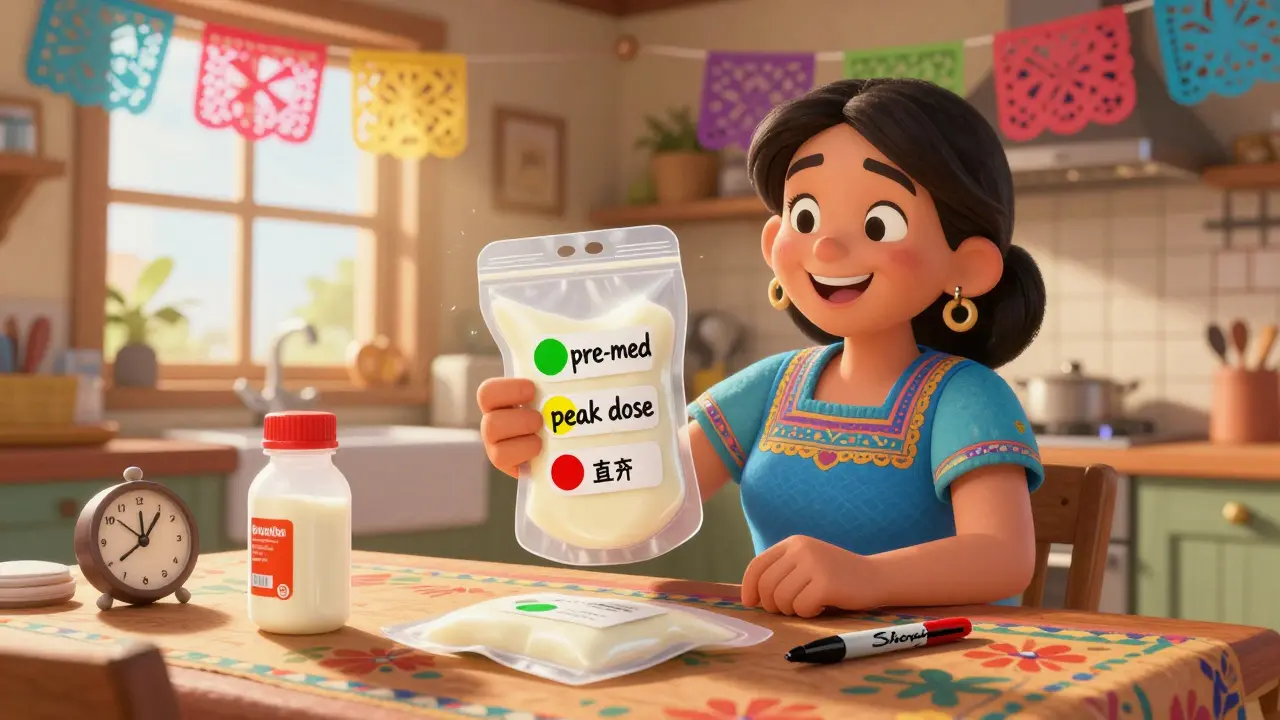
Use waterproof labels and permanent ink. If you’re using storage bags, write directly on them with a Sharpie. If you’re using bottles, stick on a label that won’t peel off in the fridge or freezer. Some moms use color-coded stickers-green for pre-med, yellow for during peak levels, red for when to discard. One mom on BabyCenter used different colored dots for each day of her antibiotic course. She didn’t waste a single ounce.
Storage Rules Change Based on Timing
Standard breast milk storage guidelines say:
- Room temperature (up to 77°F): 4 hours
- Refrigerator: up to 4 days
- Freezer: 6-12 months
But when you’re on medication, you need to split your milk into batches based on when you took the drug.
Here’s how:
- Pump before your first dose. Store this milk separately. It’s clean. You can use it anytime.
- Pump after your dose. Label it with the medication name and time taken. This milk may contain trace amounts of the drug.
- Wait for the drug to clear. Most medications peak in breast milk 1-2 hours after taking them. Some take longer. Check with your doctor or use MotherToBaby’s app (updated 2024) to find your drug’s half-life.
- Store each batch separately. Keep pre-med milk in one container, milk pumped during peak levels in another. Don’t combine them.
Example: You take ibuprofen at 8 a.m. Peak levels hit around 9-10 a.m. You pump at 11 a.m. That milk goes into a labeled bag: “Ibuprofen 200mg, 8 a.m., pumped 11 a.m.” You pump again at 3 p.m.-that’s past peak, so you can store it with your pre-med milk if you’re confident the drug has cleared.
Most drugs clear within 12-24 hours. For a 3-day antibiotic course, you might need 3-4 separate labeled batches. That sounds like a lot, but it’s better than throwing away 10 ounces of milk you could’ve used.
When Do You Actually Need to “Pump and Dump”?
“Pump and dump” sounds scary, but it’s rarely needed. You don’t need to do it for:
- Acetaminophen (Tylenol)
- Ibuprofen (Advil, Motrin)
- Most antibiotics (amoxicillin, cephalexin)
- Antihistamines (loratadine)
- Most antidepressants (sertraline)
These are all L1 or L2 on the Hale scale-meaning they’re considered safe or very low risk.
You might need to dump milk only if you’re on:
- Chemo drugs
- Radioactive isotopes (for imaging tests)
- Some anti-seizure meds (like lithium, in high doses)
- Heroin or other illegal substances
Even then, it’s often temporary. For example, if you need a thyroid scan with radioactive iodine, your doctor will tell you to pump and dump for 24-48 hours. But you can still store milk pumped before the scan and use it later.
Don’t guess. Always check with your doctor, pharmacist, or an IBCLC (International Board Certified Lactation Consultant). The Lactation Network says 61% of moms who called their consultant avoided unnecessary dumping.
Freezing and Thawing With Medications
Freezing milk is safe, even if it was pumped while on meds. But here’s the catch: never mix thawed milk with fresh milk.
If you thaw a batch of milk labeled for medication timing, use it within 24 hours. Don’t refreeze it. Don’t combine it with milk from another day.
Also, don’t fill containers to the top. Milk expands when it freezes. Leave an inch of space. One mom on Reddit froze a bag full to the brim. It burst in the freezer. She lost 8 ounces of milk-and had to clean up a sticky mess.
Thawed milk can smell soapy or sour? That’s normal. It’s due to lipase, an enzyme in breast milk. It’s not dangerous. Just swirl gently before feeding. If your baby refuses it, try scalding the milk (heat to 180°F, then cool) before freezing to deactivate the enzyme.
Traveling With Medicated Milk
Traveling with milk while on meds? Pack smart.
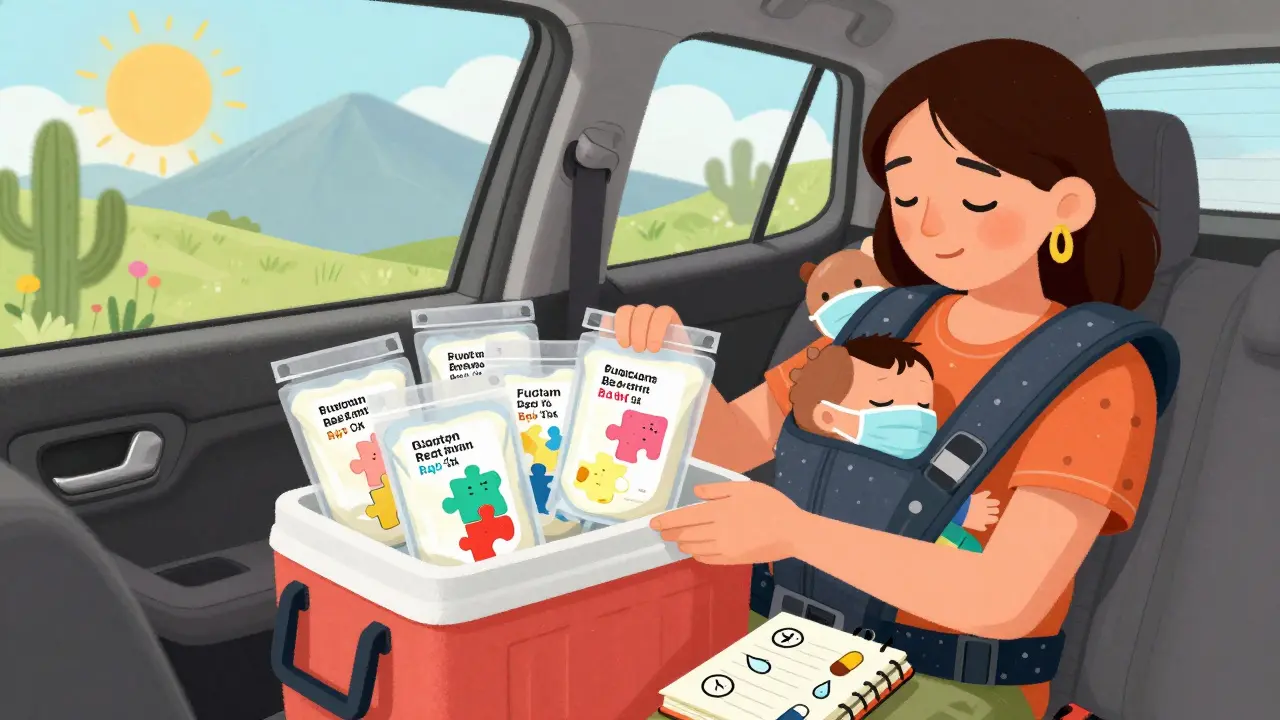
- Use an insulated cooler with frozen ice packs. CDC says it keeps milk safe for up to 24 hours.
- Keep labeled batches separate. Use small containers to avoid waste.
- Don’t rely on hotel fridges. They’re not cold enough for long-term storage.
- If you’re flying, bring a doctor’s note. TSA allows breast milk through security, even if it’s over 3.4 oz.
One mom took a 6-hour road trip while on antibiotics. She packed three labeled bags in a cooler with two frozen water bottles. She fed her baby one bag at a time, saving the rest. She didn’t dump a drop.
What to Do If You’re Confused
You’re not alone. A 2023 survey of 327 breastfeeding moms found that 63% felt unsure about how to store milk when on meds. Forty-one percent threw away milk they didn’t need to.
Here’s what to do:
- Call your pediatrician or OB-GYN. Ask: “Is this medication compatible with breastfeeding?”
- Use the MotherToBaby app (free, updated 2024). It gives you drug-specific advice and even generates printable labels.
- Ask for an IBCLC. They specialize in this stuff. Many hospitals offer free consultations.
- Don’t trust random Reddit posts or Facebook groups. Misinformation spreads fast.
Remember: Your milk is still the best food for your baby-even if you’re on meds. The benefits of breastfeeding almost always outweigh the tiny, temporary risks from medication exposure.
Common Mistakes (And How to Avoid Them)
Based on thousands of mom reports, here are the top errors-and how to dodge them:
- Mistake: Mixing all milk together. Solution: Label every batch with the medication name and time taken.
- Mistake: Dumping milk just because it’s “after the dose.” Solution: Wait 2-4 hours after taking the drug, then pump. Most drugs clear by then.
- Mistake: Using paper labels that smear. Solution: Use waterproof labels or write with a permanent marker.
- Mistake: Forgetting to label the time you took the med. Solution: Set a phone reminder: “Pump + label after meds.”
- Mistake: Assuming all meds need dumping. Solution: Check Hale’s Lactation Risk Categories. Most are L1-L2.
One mom kept a small notebook next to her pump. Each time she pumped, she wrote: “Date, Time, Med Name, Dose, Time Taken.” She didn’t lose a drop of milk during her 10-day course of amoxicillin.
Do I have to throw away my breast milk if I take a pill?
No, not usually. Only about 2% of medications require you to stop breastfeeding or dump milk. Most common meds like ibuprofen, acetaminophen, and antibiotics are safe. The key is to label your milk with the medication name and time you took it, so you can use the right milk at the right time.
How long should I wait to pump after taking medicine?
Wait 1-4 hours after taking the medication, depending on the drug. Most reach peak levels in breast milk within 1-2 hours and start to clear after that. For example, with ibuprofen, waiting 2-3 hours is usually enough. Check a reliable source like MotherToBaby or ask your pharmacist for the half-life of your specific drug.
Can I freeze milk that was pumped while on medication?
Yes, you can freeze milk pumped while on medication. Just make sure it’s properly labeled with the medication name, dose, and time taken. Freeze it in small portions (2-4 ounces) so you don’t waste any. Avoid mixing it with milk from other times unless you’re sure the medication has fully cleared.
What if I accidentally mix medicated milk with clean milk?
If you accidentally mix them, don’t panic. The amount of medication in breast milk is usually extremely low-even for drugs that aren’t considered safe. If it’s a one-time mistake and the medication is low-risk (like ibuprofen or amoxicillin), it’s unlikely to harm your baby. Going forward, use separate containers and label clearly to avoid repeat mistakes.
Is it safe to give my baby milk that was stored during my medication course?
Yes, if you’ve labeled and stored it correctly. Most mothers who follow proper labeling and timing guidelines can safely use 75-100% of their stored milk after a short-term medication course. The key is separating milk pumped before, during, and after the medication window. Never feed milk labeled for a specific medication time unless you’re sure the drug has cleared.
Can I use the same pump parts for milk before and after taking meds?
Yes, as long as you clean your pump parts thoroughly after each use. There’s no risk of cross-contamination between milk batches from the pump itself. The issue isn’t the equipment-it’s the timing of when the milk was expressed relative to when you took the medication. Just wash parts with warm, soapy water after each session.
Next Steps: What to Do Today
If you’re starting a new medication:
- Call your doctor or pharmacist. Ask: “Is this safe for breastfeeding?” and “When does it peak in breast milk?”
- Download the MotherToBaby app and enter your medication. It’ll give you a timeline.
- Buy a pack of waterproof labels and a permanent marker.
- Set up separate containers in your fridge and freezer. Label them now, before you start.
- Keep a small log: date, time pumped, med taken, time taken.
You’ve got this. Breastfeeding while on medication isn’t a stop sign-it’s a detour. With the right labels and timing, you can keep feeding your baby your milk, safely and confidently.


Written by Guy Boertje
View all posts by: Guy Boertje