
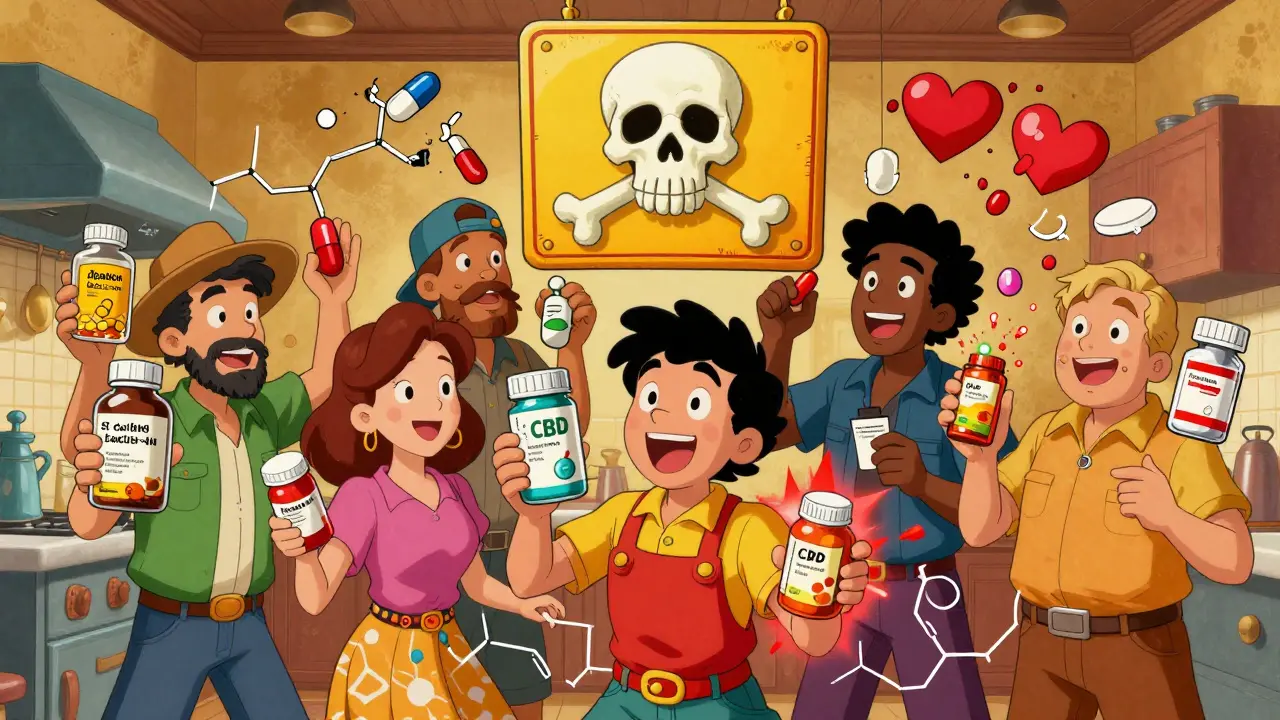
Every year, thousands of people end up in the emergency room not because of a bad workout or a wild night out, but because they took a supplement with their prescription drug. It’s not rare. It’s not exotic. It’s happening to your neighbor, your parent, maybe even you - and most people have no idea it’s even possible.
Take St. John’s wort. You might think it’s just a natural way to lift your mood. But if you’re on birth control, antidepressants, or even heart meds like digoxin, this herb can make those drugs useless. One study showed it drops the blood level of cyclosporine - a drug transplant patients rely on - by 57%. That’s not a glitch. That’s a life-threatening drop. And yet, most supplement bottles don’t warn you about it.
Why Supplements Aren’t Like Medicine
Here’s the big difference: when you take a prescription drug, the FDA has already tested it for safety, dosage, and how it reacts with other drugs. Every interaction is mapped out. But dietary supplements? They’re treated like food. Under the 1994 Dietary Supplement Health and Education Act (DSHEA), companies don’t need to prove their products are safe before selling them. The FDA can only step in after someone gets hurt.
This means you’re walking into a blind spot. A 2019 review found that only 0.5% of supplements have formal interaction studies published in medical journals. Meanwhile, 78% of supplement labels don’t mention a single drug interaction - even though we know many of them cause serious problems.
High-Risk Combinations You Can’t Afford to Ignore
Not all supplements are equal when it comes to danger. Some are quietly dangerous. Here are the top offenders:
- St. John’s wort: This one’s the most notorious. It speeds up how your liver breaks down drugs. That means medications like warfarin, SSRIs, birth control pills, and even some cancer drugs get flushed out of your system too fast. One case report showed a woman on carbamazepine for seizures had a breakthrough seizure after starting St. John’s wort - her drug levels dropped by over half.
- Warfarin + vitamin K or ginkgo: Warfarin is a blood thinner. It’s delicate. Too little, and you clot. Too much, and you bleed. Vitamin K (found in green tea, kale supplements, or multivitamins) directly fights warfarin’s effect. Ginkgo biloba? It thins blood too. Together, they can push your INR from a safe 2.5 to over 6.5. That’s a bleeding emergency.
- Magnesium antacids + antibiotics: If you’re on ciprofloxacin or levofloxacin, taking an antacid with magnesium can slash your antibiotic absorption by up to 90%. You think you’re treating an infection - but you’re not even getting the drug into your system.
- Calcium supplements + thyroid meds: Levothyroxine (Synthroid) needs to be taken on an empty stomach. Calcium, even in a multivitamin, can block its absorption by 25-50%. If you’re not getting the full dose, your thyroid levels stay off - and you’re tired, gaining weight, or feeling depressed for no reason.
- CBD (cannabidiol) + clobazam: CBD is everywhere now. But it slows down liver enzymes that break down clobazam, a seizure drug. One study showed clobazam levels jumped 60-500% in patients taking both. That’s not a boost - that’s overdose risk.
These aren’t hypotheticals. They’re documented. The FDA’s Bad Ad program got over 1,800 reports of supplement-drug interactions between 2019 and 2022. Warfarin cases made up 32% of them. Antidepressant interactions? 24%. That’s not noise - that’s a pattern.
Who’s at the Highest Risk?
You might think this only affects older people on a dozen pills. But it’s worse than that.
Adults over 60 are the most vulnerable. Nearly 85% of them take supplements. And they’re also the group most likely to be on 4-5 prescription drugs. That’s a perfect storm. A 2021 study found that 65% of severe supplement-drug interactions came from herbal products - even though they make up only 15% of supplement sales. That’s a massive mismatch between popularity and danger.
But it’s not just seniors. Younger people are popping melatonin, omega-3s, ashwagandha, and protein powders without thinking twice. And if they’re on anxiety meds, blood pressure drugs, or birth control? The risk is still there.
Why Nobody Talks About This
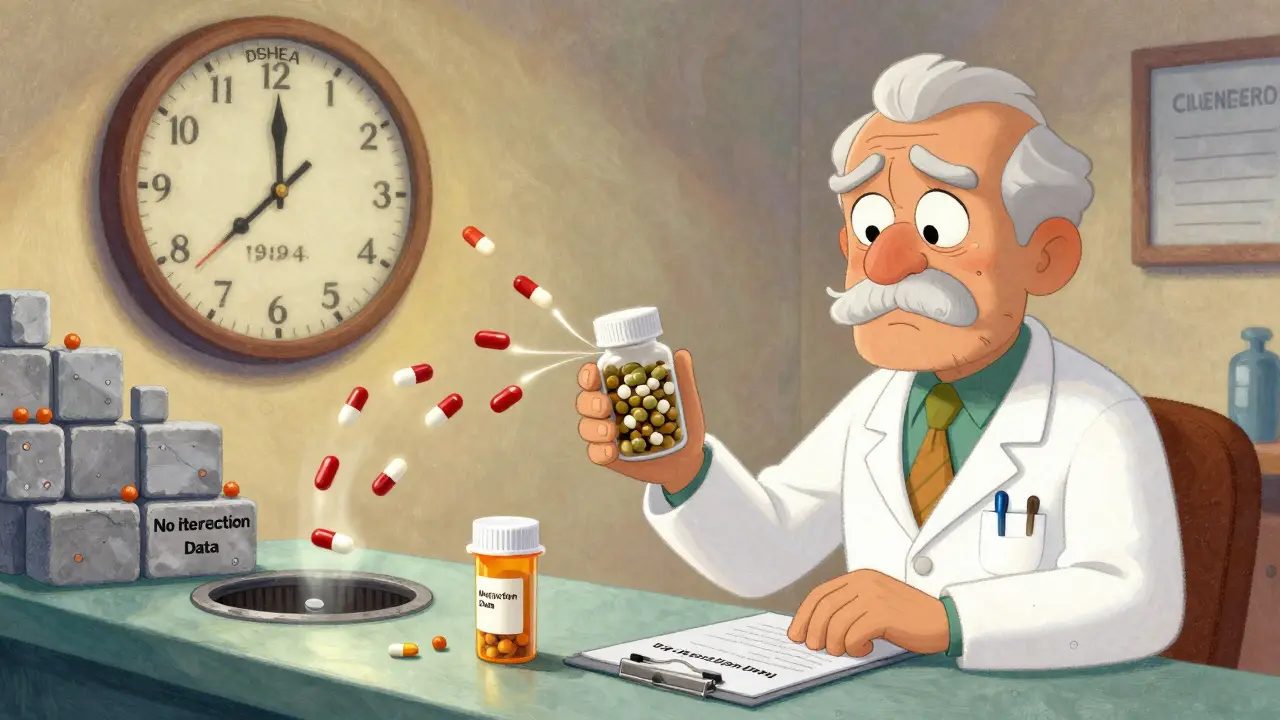
Most patients don’t tell their doctors about supplements. A 2018 study found that 43-69% of people never mention them during a visit. Why? Because they assume their doctor doesn’t care. Or they think supplements are “harmless.” Or they’ve been told, “Don’t worry about it.”
One Reddit user wrote: “My doctor doesn’t know anything about supplements anyway.” That’s the mindset. And it’s deadly.
Meanwhile, doctors aren’t trained for this. A 2020 study showed only 32% of pharmacists could correctly identify major supplement-drug interactions. After a 4-hour training course? That jumped to 87%. The problem isn’t that doctors are careless. It’s that they’re under-equipped.
What You Can Do - Right Now
You don’t need to quit supplements. You just need to be smarter.
- Ask yourself: “What am I taking, and why?” Write down every supplement - name, dose, frequency. Include herbal teas, powders, and gummies. Don’t assume “natural” means safe.
- Bring it to your doctor or pharmacist. Say: “I take these. Are they safe with my meds?” Don’t wait for them to ask. Most won’t.
- Check reliable sources. Use the NCCIH website or the Natural Medicines Database. Type in your supplement and your drug. If it says “severe interaction,” stop and call your provider.
- Watch for signs. Unexplained bruising? Dizziness? Sleepiness? A seizure? A sudden change in how your medication works? These could be red flags.
- Report adverse events. If something goes wrong, report it to the FDA’s MedWatch program. Your report could help save someone else’s life.
The Bigger Picture
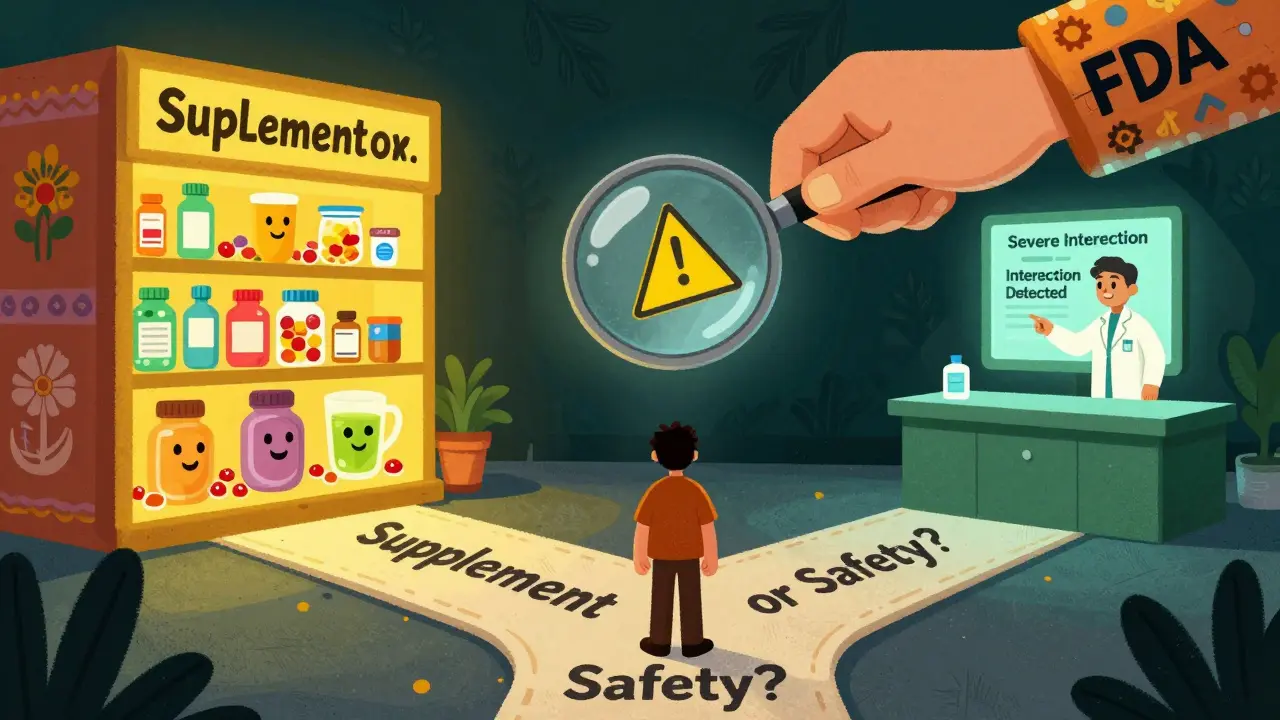
The supplement industry is booming. The U.S. market hit $52 billion in 2022 and is projected to hit $82 billion by 2028. But behind that growth is a dangerous gap in regulation. The FDA can’t act until harm is done. And by then, it’s often too late.
Some reform is coming. In 2023, a bill was introduced to require warning labels on high-risk supplements. The NCCIH is spending $15.7 million on research through 2025. But until laws change, you’re the last line of defense.
Supplements aren’t the enemy. Ignorance is.
Frequently Asked Questions
Can I take vitamin D with my blood pressure medication?
Generally, yes. Vitamin D has very few known interactions with blood pressure medications. However, if you’re on a calcium channel blocker like diltiazem or verapamil, very high doses of vitamin D could raise calcium levels, which might affect heart rhythm. Stick to standard doses (600-800 IU/day), and get your calcium and vitamin D levels checked if you’re taking more than 4,000 IU daily.
Is it safe to take fish oil with warfarin?
Fish oil (omega-3s) can slightly thin the blood. While most studies show no major risk at typical doses (under 3 grams/day), there’s a small chance it could increase bleeding when combined with warfarin. If you’re on warfarin and want to take fish oil, talk to your doctor first. You’ll likely need more frequent INR checks to make sure your blood clotting stays in the safe range.
Do multivitamins cause drug interactions?
Most multivitamins are low-risk, but they’re not harmless. The biggest concern is vitamin K, which can interfere with warfarin. Calcium and iron in multivitamins can block absorption of thyroid meds, antibiotics, and some osteoporosis drugs. Always take thyroid meds on an empty stomach, at least 4 hours before or after your multivitamin. And if you’re on warfarin, keep your vitamin K intake consistent - don’t suddenly start taking a high-dose multivitamin.
Why don’t supplement labels warn about drug interactions?
Because the law doesn’t require it. Under DSHEA, supplement manufacturers aren’t required to prove safety or test for interactions before selling. The FDA can only act after harm occurs. That’s why you’ll see warning labels on prescription drugs but not on a bottle of St. John’s wort - even though the herb is far more likely to cause serious problems.
What should I do if I think a supplement is interacting with my drug?
Stop taking the supplement immediately. Contact your doctor or pharmacist. Don’t wait for symptoms to get worse. If you’re on a drug like warfarin, an antidepressant, or an immunosuppressant, even a small interaction can be dangerous. Document what you took, when, and what symptoms you experienced. Report it to the FDA through MedWatch. Your report helps build the evidence needed to force change.
Supplements can be helpful. But they’re not harmless. The moment you start taking them alongside prescription drugs, you enter a gray zone where the rules don’t apply. You’re not just taking a pill. You’re playing with your body’s chemistry. And if you don’t know the rules - you’re already losing.


Written by Guy Boertje
View all posts by: Guy Boertje