
When a patient walks into your office and asks why you’re switching them from a brand-name drug to a generic, what do you say? The truth is, most providers don’t need to guess anymore. Years of rigorous studies, real-world data, and regulatory oversight have given us a clear answer: generic drugs work just as well as brand-name drugs for nearly every patient, in nearly every condition.
How Do We Know Generics Are Just as Effective?
The FDA doesn’t approve generics based on hope or cost savings. It requires proof. Every generic drug must meet the same strict standards as the brand-name version. That means identical active ingredients, same strength, same dosage form, and same route of administration. But the real test? Bioequivalence.
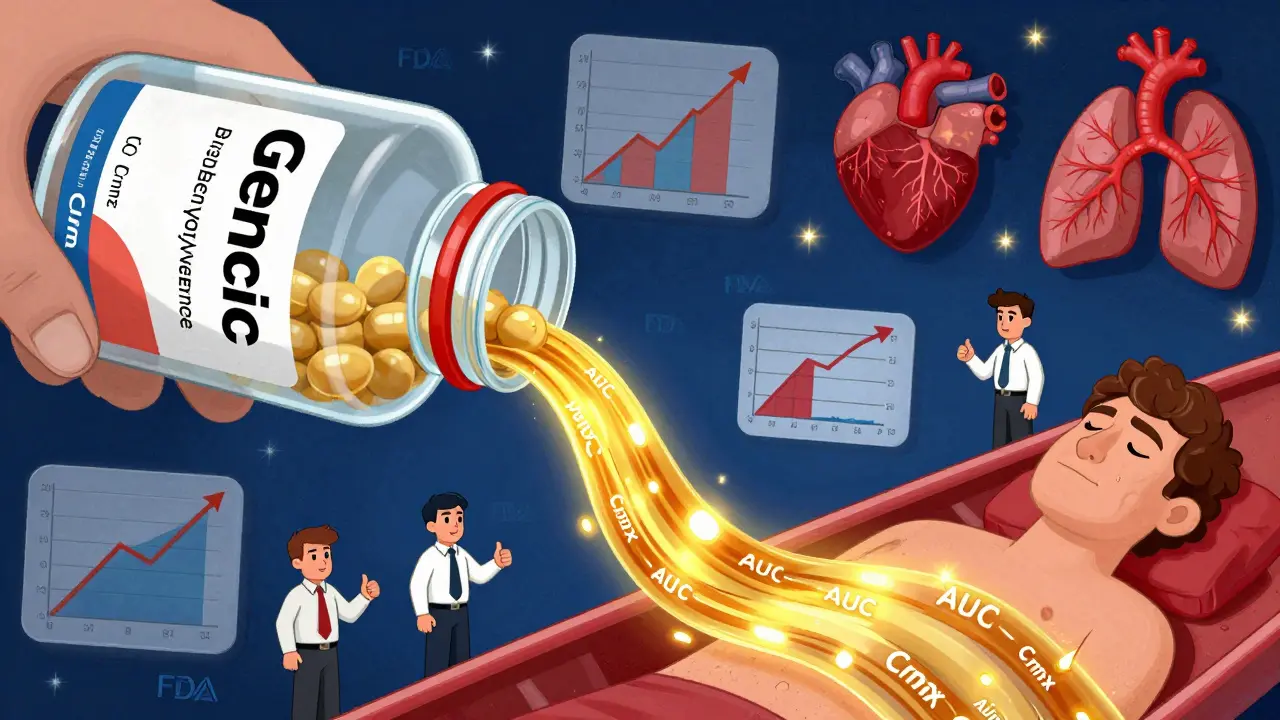
Here’s how it works: a generic manufacturer must prove that the drug enters the bloodstream at the same rate and to the same extent as the brand. The FDA requires that the average concentration of the drug in the blood - measured by AUC and Cmax - falls within 80% to 125% of the brand-name drug’s levels. For most drugs, that’s a wide enough range to account for normal body variation. For narrow therapeutic index drugs like warfarin, levothyroxine, or tacrolimus, the standards are even tighter. Studies using scaled bioequivalence methods show these generics still perform just as reliably.
Over 13,000 generic drugs have been approved since 1984, and the data is overwhelming. A 2019 study in PLOS Medicine analyzed over 1.3 million patient records across 14 clinical endpoints - things like heart attacks, hospitalizations, and blood sugar control. In 12 of those 14 cases, there was no meaningful difference between generic and brand-name drugs. The hazard ratios hovered right around 1.00, meaning the risk of bad outcomes was essentially the same.
What About the Exceptions? Are Some Generics Riskier?
Some providers worry about psychiatric drugs. A few studies showed slightly higher psychiatric hospitalization rates with generics like escitalopram and sertraline. At first glance, that sounds alarming. But here’s the catch: when researchers compared authorized generics (made by the brand company itself) to the original brand, they saw the same pattern. That tells us it’s not the generic formulation causing the issue - it’s likely patient perception.
People believe brand-name drugs are better. When they switch, even if the medicine is identical, they may feel worse. They might stop taking it. They might blame the generic. That’s not a drug failure - it’s a psychological effect. And it’s why the FDA found no increased switch-back rates to brand-name drugs after patients started on generics. The data shows patients don’t leave generics because they stop working - they leave because they think they’re not working.
There are also rare cases where complex delivery systems - like inhalers, topical creams, or injectables - are harder to replicate exactly. That’s why the FDA assigns ‘B’ ratings to about 3% of generics. These aren’t unsafe. They just need extra caution. If a patient is on a B-rated generic, monitor them closely. But for the other 97% - the A-rated generics - the evidence is solid.
Real Patients, Real Results
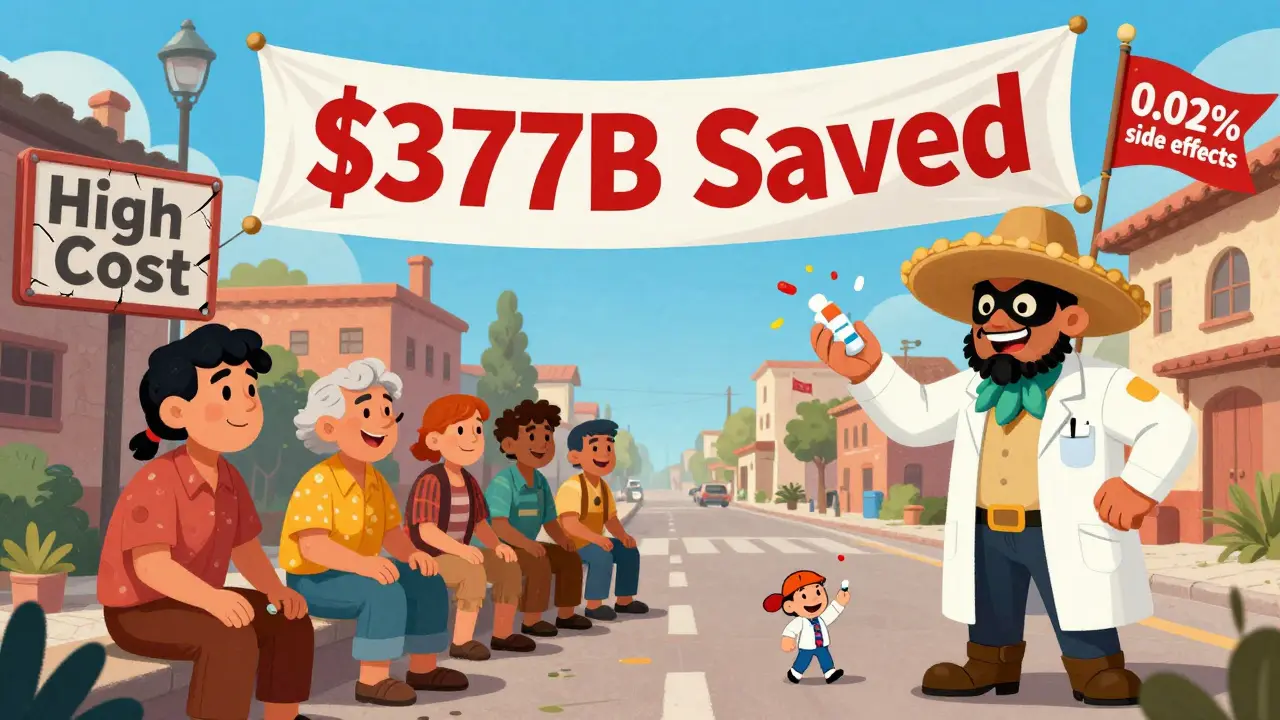
Let’s talk numbers that matter. In 2021, generic drugs saved the U.S. healthcare system $377 billion. That’s not theoretical. That’s real money - money that keeps clinics open, keeps insurance premiums lower, and keeps patients from skipping doses because they can’t afford their meds.
One study followed 3.5 million Medicare beneficiaries over five years. At first, it looked like generic users had better survival rates. But when researchers adjusted for the fact that healthier, wealthier patients were more likely to get generics, the gap disappeared. The truth? Generics don’t make people live longer - they just make it possible for more people to stay on life-saving meds.
And it’s not just the U.S. A 2021 review across European countries found that 92% of studies showed no difference in outcomes between generic and brand-name cardiovascular drugs. The science is global. The results are consistent.
Why Do Some Patients Still Resist?
It’s not about the science. It’s about the look. Generics often look different - different color, shape, or markings. Patients see that and think, “This isn’t the same.” One 2019 FDA study found that 40% of patients who switched to a generic believed the drug was weaker, even when they were taking the exact same medication.
That’s why communication matters. Don’t just write a prescription. Talk to your patient. Say this: “This generic has the same active ingredient, same dose, and same effect as your brand-name drug. The FDA requires it to be proven identical before it’s sold. The only difference is the price - and it’s 85% cheaper.”
Most patients will accept that. Especially when they see their copay drop from $75 to $10.
What Does the Evidence Mean for Your Practice?
Here’s what you need to do:
- Prescribe generics by default - unless there’s a clear, documented reason not to.
- Know the Orange Book. If a drug is rated ‘A’, it’s therapeutically equivalent. No exceptions.
- Don’t assume a patient’s complaint about a generic means it’s ineffective. Ask: “Did you notice a change in how you feel, or just how the pill looks?”
- Use authorized generics when available. They’re made by the brand company and often ease patient concerns.
- Document your decision. If you choose a brand-name drug, note why - cost, patient preference, or clinical necessity. Don’t let inertia drive your choices.
And here’s the kicker: the FDA’s adverse event database shows only 0.02% of all reported drug side effects are linked to generics. Brand-name drugs? 3.2%. That’s not a coincidence. It’s a signal. Generics are not riskier. They’re safer - because more people can afford to take them consistently.
What’s Changing Now?
The FDA is updating its standards for complex generics - things like biosimilars and inhaled medications. That’s good news. It means more high-cost drugs will soon have affordable alternatives.
And Congress is cracking down on “product hopping” - when brand companies make tiny changes to their drugs just to extend patents. That’s a tactic designed to keep generics off the market. But with new rules, that’s getting harder.
Meanwhile, real-world data from big health databases is growing. A 2023 study of 2.1 million diabetics found zero difference in HbA1c control between generic and brand-name metformin. The mean difference? -0.02%. That’s noise, not a signal.
Bottom Line
Generics aren’t a compromise. They’re the standard. The evidence isn’t just strong - it’s overwhelming. For 97% of prescriptions, choosing a generic isn’t a cost-saving trick. It’s the best clinical decision you can make.
Patients aren’t getting second-rate care when they get a generic. They’re getting the same care, at a fraction of the cost. And in a system where affordability determines access, that’s not just smart economics - it’s ethical medicine.


Written by Guy Boertje
View all posts by: Guy Boertje