
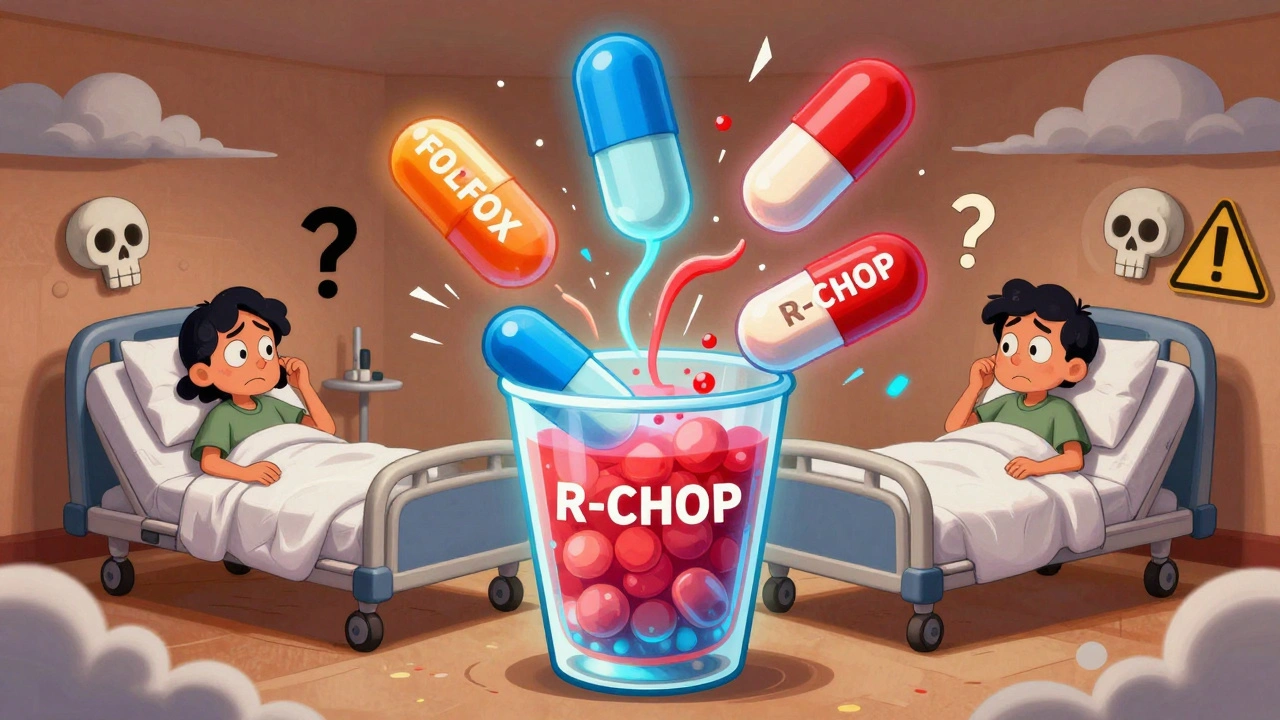
When a cancer patient gets a prescription for a combination drug regimen-say, FOLFOX for colorectal cancer or R-CHOP for lymphoma-they’re not just getting one medicine. They’re getting three, four, or even five drugs working together. Each one has to hit the right dose at the right time. And when those drugs switch from brand to generic, things get messy. It’s not like swapping one painkiller for another. In cancer treatment, even tiny differences in how a drug is absorbed can mean the difference between beating the disease and watching it come back.
What Bioequivalence Really Means in Cancer Treatment
Bioequivalence sounds like a technical term, but it’s really about this: does the generic version work the same way as the brand? For single drugs, regulators like the FDA say yes if the amount of active ingredient in the bloodstream (measured as AUC and Cmax) falls within 80-125% of the original. That’s the standard for most pills-antibiotics, blood pressure meds, even some antidepressants. But cancer drugs don’t play by those rules. Many are narrow therapeutic index drugs. That means the gap between a dose that works and one that’s toxic is razor-thin. Methotrexate, for example, can cause fatal bone marrow suppression if levels creep just 10% too high. In combination regimens, you’re stacking multiple drugs like this. One generic version might absorb slightly slower. Another might break down faster in the gut. Alone, that might not matter. Together? It can throw off the whole balance.Why Combination Therapies Break the Bioequivalence Model
The current system was built for single drugs. It assumes you can test one active ingredient at a time. But in a combination like R-CHOP-rituximab (a biologic), cyclophosphamide, doxorubicin, vincristine, and prednisone-you’re dealing with both small-molecule chemicals and complex proteins. Each one has its own absorption path. Each one can interact with the others. Here’s the problem: if you substitute just one generic component-say, switching from branded vincristine to a generic version-you’re not testing the whole combo. You’re assuming the rest stays the same. But what if the generic vincristine changes how quickly doxorubicin gets absorbed? That interaction might not show up in a standard bioequivalence study done on healthy volunteers. It might only show up in a real patient with cancer, whose liver and kidneys are already stressed from treatment. A 2023 survey of oncology pharmacists found that 57% had seen cases where swapping one generic in a combo led to unexpected side effects or reduced effectiveness. One documented case involved a patient on R-CHOP who developed severe nerve pain after a generic vincristine was substituted. The brand version had a different formulation that slowed release. The generic released faster, spiking blood levels and triggering toxicity.The Biologic Problem: Biosimilars Aren’t Bioequivalent
Then there’s the rise of biologics in cancer care-drugs like trastuzumab (Herceptin), rituximab, and cetuximab. These aren’t made from chemicals. They’re made from living cells. That means you can’t just copy them. You can only make a biosimilar. Biosimilars don’t need to prove bioequivalence. They need to prove comparability through clinical trials. That’s more expensive, more time-consuming, and more complex. But even then, regulators don’t test them as part of a combo. So if a hospital switches from branded trastuzumab to a biosimilar, then also swaps out the chemo drugs around it, no one’s looking at the whole picture. Studies show biosimilars like trastuzumab work just as well as the original in survival rates. But that’s when they’re used the same way. When you mix them with multiple generics, you’re entering uncharted territory. The economic pressure to cut costs pushes hospitals to swap everything. But the science isn’t ready to guarantee safety.
Who’s Really at Risk?
It’s not just the patients. It’s the oncologists, pharmacists, and nurses trying to make sense of it all. A 2023 survey from the American Society of Health-System Pharmacists found that 68% of hospital formulary committees require extra clinical data before approving generic substitution in combination regimens. That’s not because they’re against generics. It’s because they’ve seen the fallout. Patients are scared too. A 2024 survey by Fight Cancer found that 63% of patients worry about switching to generics in combination therapy. Forty-one percent said they’d ask for the brand name-even if it cost them thousands more-just to feel safer. That’s not irrational. When your life depends on a drug working perfectly, you don’t want to gamble on a 10% absorption difference.What’s Being Done About It?
Regulators are starting to wake up. The FDA launched the Oncology Bioequivalence Center of Excellence in early 2024. Their goal? To develop new standards for combo therapies. The European Medicines Agency is already requiring clinical endpoint studies for high-risk combinations-meaning they don’t just look at blood levels, they look at whether patients live longer or have fewer side effects. New guidelines from the International Consortium for Harmonisation of Bioequivalence Standards in Oncology recommend tighter limits-90-111% instead of 80-125%-for narrow therapeutic index drugs in combinations. They also now require food-effect studies for every oral component. Why? Because a generic pill might absorb fine on an empty stomach, but with food, it behaves differently. And cancer patients often eat poorly. That difference could matter. Some institutions are building tools to help. UCSF created a decision support system that flags combination regimens with narrow therapeutic index drugs. If a pharmacist tries to swap a generic, the system alerts them in real time. At MD Anderson, a study of 1,247 patients showed that switching to generic capecitabine in combination with oxaliplatin had no impact on survival or side effects. That’s the good news. But that’s one combo. There are hundreds more.
The Cost vs. Safety Tightrope
The math is clear: generics save money. Generic paclitaxel costs 80% less than the brand. Generic trastuzumab biosimilars cut treatment costs by $6,000 to $10,000 per cycle. The U.S. healthcare system could save $14.3 billion a year if generics were used safely in cancer care. But savings shouldn’t come at the cost of safety. The current system treats all drugs the same. It doesn’t account for the fact that combining five drugs isn’t like combining two. It doesn’t account for how cancer changes how your body handles medicine. It doesn’t account for the fact that patients aren’t healthy volunteers in a lab-they’re tired, malnourished, and often on multiple other meds. The solution isn’t to ban generics. It’s to treat combination therapies differently. Require testing of the whole combo, not just each piece. Use modeling to predict interactions. Train pharmacists to spot high-risk switches. Give doctors tools to make informed choices.What Patients and Providers Should Do Now
If you’re a patient: ask. Don’t assume a generic is automatically safe in a combo. Ask your oncologist or pharmacist: Is this substitution approved for this specific combination? If you’ve had a reaction after a switch, report it. Your experience matters. If you’re a provider: don’t rely solely on the FDA’s Orange Book. That list says if a drug is therapeutically equivalent-but it doesn’t say if it’s safe when mixed with other generics. Use institutional protocols. Check your hospital’s formulary guidelines. When in doubt, stick with the branded combo until data proves the generic version is safe in that context.The Future: One Regimen, One Test
The next big leap will be testing combination regimens as a whole. Imagine a single bioequivalence study that tests FOLFOX as one unit-not 5 separate pills, but one treatment package. That’s what the EMA’s pilot program is trying. It’s expensive. It’s slow. But for cancer, it’s necessary. By 2030, the National Cancer Institute predicts 35-40% of current combination therapies will need this kind of specialized testing. The tools are coming-physiologically based pharmacokinetic (PBPK) modeling can simulate how drugs interact in the body. AI can predict which combinations are most likely to cause problems. But until then, we’re flying blind in a lot of cases. The system was built for simpler times. Cancer treatment isn’t simple anymore. And neither should our rules be.Are generic cancer drugs safe in combination regimens?
Some are, but not all. Single-agent generics like capecitabine or paclitaxel have proven safe in studies. But when multiple generics are mixed in a combination-especially with narrow therapeutic index drugs or biologics-the risk of unexpected interactions increases. Always check if the specific combo has been studied as a unit.
Why can’t we just use the same bioequivalence standards for cancer combos as we do for other drugs?
Because cancer drugs often have very narrow therapeutic windows. A 10% difference in blood levels can cause toxicity or treatment failure. Also, combinations involve multiple drugs that can interact in unpredictable ways. Standard bioequivalence studies test single drugs in healthy people-not sick patients on five drugs at once.
What’s the difference between a generic and a biosimilar in cancer treatment?
Generics are exact chemical copies of small-molecule drugs, like chemotherapy pills. Biosimilars are similar but not identical copies of complex biologic drugs, like monoclonal antibodies. Biosimilars require clinical trials to prove safety and effectiveness, while generics only need bioequivalence studies. Neither is tested as part of a full combination regimen.
Can switching to a generic cancer drug cause side effects?
Yes, especially in combination therapies. There are documented cases where switching a single generic component-like vincristine or methotrexate-led to increased neurotoxicity or bone marrow suppression. These effects often come from subtle formulation differences that change how fast the drug enters the bloodstream.
How can I know if my cancer combo uses generics that are safe?
Ask your oncology pharmacist or oncologist. Check your hospital’s formulary guidelines. Look for institutional protocols that evaluate combinations as a whole-not just individual drugs. If your treatment includes a biologic or a narrow therapeutic index drug, request documentation showing the specific combo has been studied.
Is there a list of safe generic cancer combos?
No official global list exists yet. The FDA’s Orange Book shows which single drugs are therapeutically equivalent, but it doesn’t rate combinations. Some institutions, like UCSF and MD Anderson, have internal guidelines. The European Medicines Agency is starting to publish recommendations for high-risk combos. Until a standardized system is in place, rely on expert-led protocols at your treatment center.


Written by Connor Back
View all posts by: Connor Back