

Breastfeeding Medication Timing Calculator
Calculate the safest time to nurse your baby after taking medication to minimize drug exposure. Based on FDA guidelines and LactMed database information.
Recommended Timing
Drug Information
When you’re breastfeeding and need to take medication, it’s natural to worry about what your baby is getting through your milk. The good news? You don’t have to choose between staying healthy and keeping your baby safe. Medication timing-when you take your pill in relation to nursing-is one of the most effective, science-backed ways to cut infant drug exposure by up to 75%. This isn’t guesswork. It’s based on how your body processes medicine and how it moves into breast milk.
How Medication Gets Into Breast Milk
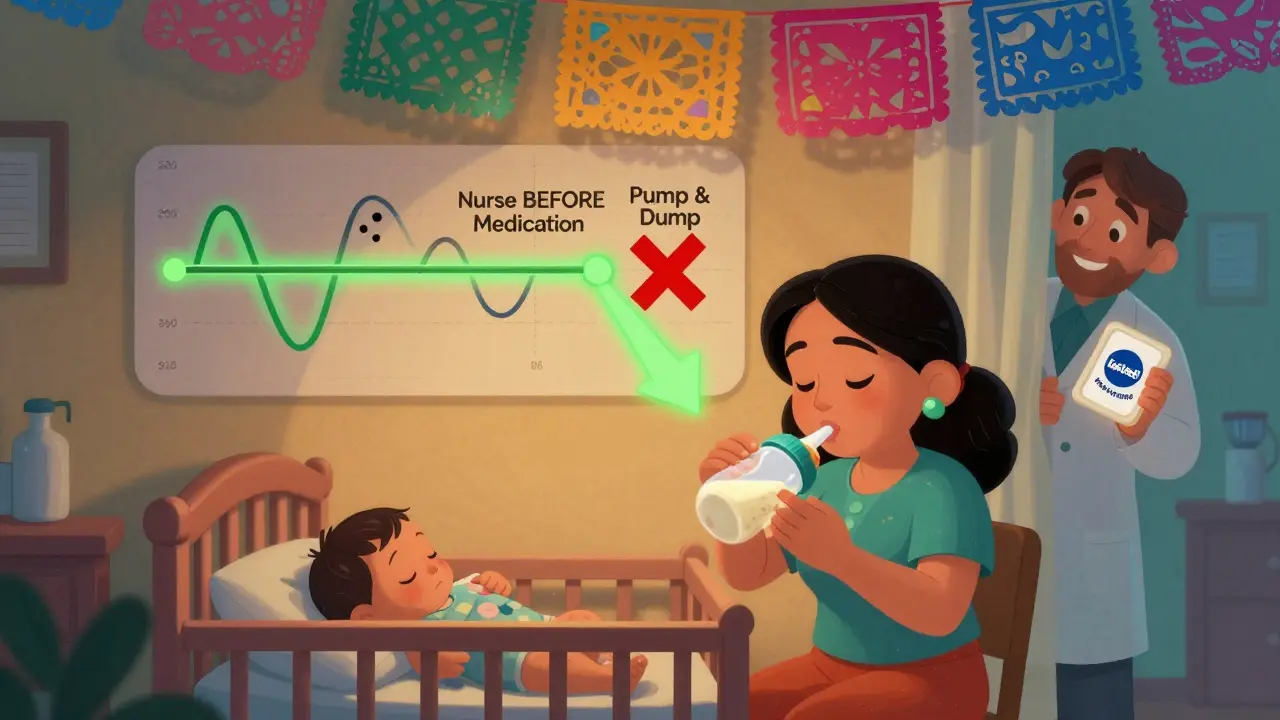
Breast milk doesn’t just copy your blood. Drugs enter milk through a process tied to your bloodstream. When you take a pill, it gets absorbed, reaches its highest level in your blood (called the peak), and then slowly drops. That peak is when the most drug flows into your milk. If you nurse right after taking medicine, your baby gets the biggest dose. But if you wait, you let your body clear most of it before the next feeding.
The key metric doctors use is called the Relative Infant Dose (RID). It’s the percentage of your dose that your baby actually gets through milk. Anything under 10% is generally considered safe. For example, codeine has an RID of 0.6-8.1%, while morphine can be as high as 9-35%. That’s why timing matters so much for some drugs-but not others.
When to Take Your Medicine: Timing by Drug Type
Not all medications work the same way. The timing strategy changes depending on how fast the drug peaks and how long it lasts.
- Short-acting painkillers like ibuprofen and acetaminophen are safe and don’t need strict timing. They have very low RIDs (under 1%) and clear from your system quickly.
- Opioids like oxycodone, hydrocodone, and morphine peak in 0.5 to 2 hours. The best move? Nurse your baby right before you take the pill. Then wait at least 2-3 hours before the next feed. That way, your baby gets the smallest amount possible. The American Academy of Pediatrics and the Academy of Breastfeeding Medicine both recommend this.
- Tramadol and codeine come with FDA warnings. Some people metabolize them too fast, turning them into dangerous levels of morphine in their bodies. Even with perfect timing, these aren’t recommended. Avoid them if you can.
- Benzodiazepines like alprazolam (Xanax) peak in 1-2 hours and clear in about 11 hours. Nurse before taking, then wait 3-4 hours. But diazepam (Valium) is a different story-it stays in your system for up to 48 hours. Timing barely helps here. If you need it, use the lowest dose and talk to your doctor about alternatives.
- Antidepressants and psychiatric meds like sertraline or fluoxetine have long half-lives. Timing helps less, but using immediate-release versions (not extended-release) gives you more control. Take them right after a feeding, and space out feeds as much as possible.
What About the First Few Days After Birth?
Here’s something many moms don’t know: in the first 3 to 4 days after delivery, your milk volume is tiny. You’re making colostrum, not mature milk. That means even if you take a medication, your baby gets almost none of it. You can nurse normally without worrying about timing during this window. Once your milk supply ramps up (usually around day 5), then timing becomes critical.
Practical Strategies That Actually Work
Real life doesn’t always line up with textbook timing. Babies feed on their own schedule-sometimes every 90 minutes. Here’s how to make it work:
- Pump and store milk before you take a dose. If you know you’ll need a strong painkiller at night, pump an extra bottle earlier in the day. Use it for the next feeding. This works great for weekend trips, hospital stays, or when you’re on a strict schedule.
- Time your dose with long stretches. If your baby sleeps 4-5 hours at night, take your medication right after you put them down. That way, they sleep through the peak.
- Use immediate-release pills. If your doctor prescribes an extended-release version, ask if there’s an immediate-release alternative. It gives you more control over timing.
- Keep a log. Note when you take your medicine and when you nurse. After a few days, you’ll start seeing patterns. You might notice your baby is more alert after you take oxycodone at 8 a.m.-and less so if you wait until after the 10 p.m. feeding.
What Doesn’t Work
Some myths persist. Don’t waste time on these:
- “Pumping and dumping” after every dose. This doesn’t reduce the amount of drug in your milk. It just makes you tired. The drug leaves your milk naturally as your blood levels drop. Pumping won’t speed that up.
- “I’ll just stop breastfeeding”. For most medications, the risk is low if you time them right. Stopping breastfeeding has real downsides for both you and your baby-increased risk of postpartum depression, harder weight loss, and higher risk of breast cancer later in life.
- “All meds are dangerous”. The vast majority of medications are safe during breastfeeding. Only a handful-like lithium, chemotherapy drugs, or certain radioactive tracers-require a pause. Most others? You just need to time them right.

Who Can Help You?
You don’t have to figure this out alone. The LactMed database, run by the National Library of Medicine, has detailed info on over 1,000 medications and their timing recommendations. You can search it for free. But even better? Talk to a lactation consultant or your pharmacist. They know which drugs are safe, which need timing, and which should be avoided entirely.
According to CDC surveys, only 35% of general doctors give specific timing advice. But 78% of lactation consultants do. If your provider says, “Just take it and don’t worry,” ask for a referral. Your baby’s safety is worth the extra step.
What’s New in 2026?
Research is getting smarter. In 2022, a study in the Journal of Human Lactation showed that testing for a gene called CYP2D6 could predict how someone metabolizes codeine. If you’re an ultra-rapid metabolizer, even small doses can turn into dangerous levels of morphine. This kind of genetic testing isn’t routine yet-but it’s coming.
Also, 27 U.S. states now require Medicaid to cover breastfeeding counseling that includes medication timing. That means more moms are getting the help they need. The goal isn’t to scare you off meds-it’s to make sure you can take what you need without putting your baby at risk.
Bottom Line: You Can Do This
You’re not alone. Hundreds of thousands of moms take medication while breastfeeding every year. With smart timing, you can protect your baby and still take care of yourself. The key is knowing your drug’s peak time and half-life. Use the 2-3 hour window after your dose to space out feeds. Talk to your pharmacist. Use LactMed. Pump ahead if you need to. And remember: most medications are safe. You just need to plan.
Is it safe to breastfeed while taking painkillers?
Yes, most painkillers are safe. Ibuprofen and acetaminophen are first-choice options because they transfer very little into breast milk. For stronger pain, opioids like hydrocodone or morphine are okay if timed correctly-nurse before taking the dose, then wait 2-3 hours before the next feed. Avoid codeine and tramadol due to FDA warnings about unpredictable metabolism in babies.
How long should I wait after taking medicine before breastfeeding?
Wait 2-3 hours after taking most short-acting medications. This lets your blood levels drop after the peak. For example, if you take oxycodone at 8 p.m., wait until 10-11 p.m. to nurse again. For drugs with long half-lives like diazepam, timing doesn’t matter as much because the drug stays in your system for days.
Should I pump and dump after taking medication?
No. Pumping and dumping doesn’t remove the drug from your milk faster. The drug leaves your milk as your blood concentration drops naturally. Pumping only removes milk you’ve already made-it won’t reduce exposure. It’s better to time your dose around feeds or pump ahead of time.
Can I take antidepressants while breastfeeding?
Yes. Medications like sertraline and paroxetine have low transfer into breast milk and are commonly recommended. Use immediate-release versions if possible, and take them right after a feeding. Timing helps, but it’s less critical than with painkillers. The benefits of treating postpartum depression usually outweigh the small risk of infant exposure.
What if my baby sleeps through the night? Can I take my medicine then?
Absolutely. If your baby sleeps 5-6 hours at night, take your medication right after you put them down. That way, the peak concentration happens while they’re sleeping, and the next feeding is hours later when levels are much lower. This is one of the easiest ways to minimize exposure without changing your routine.
Are there any medications I should avoid completely while breastfeeding?
Yes. Codeine and tramadol carry FDA warnings because some babies can’t metabolize them properly and may develop dangerous breathing problems. Lithium, chemotherapy drugs, and radioactive isotopes are also not safe. Always check with your doctor or use the LactMed database before taking any new medication.


Written by Guy Boertje
View all posts by: Guy Boertje